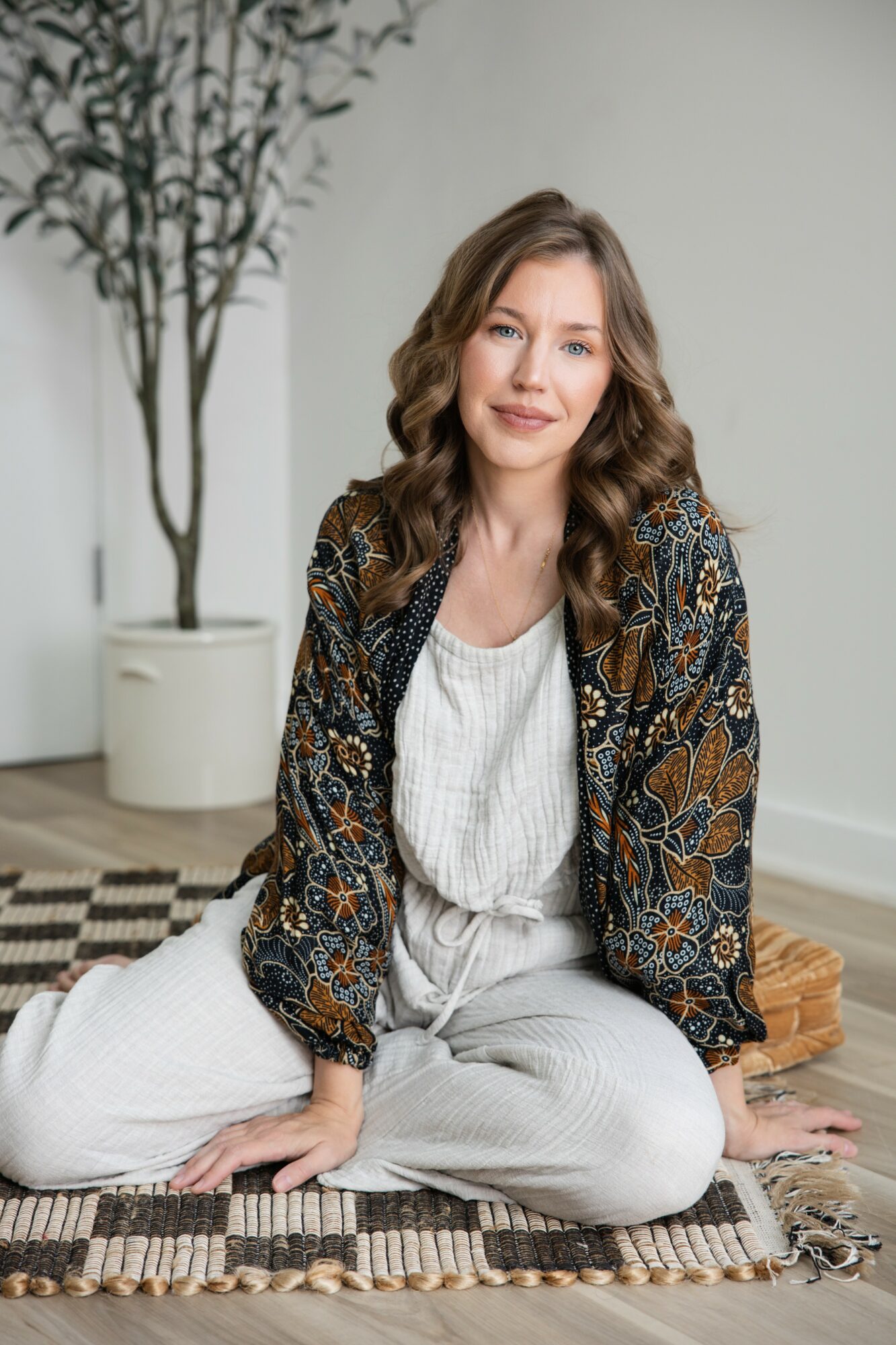
Today we’d like to introduce you to Sarah Bland.
Hi Sarah , thanks for joining us today. We’d love for you to start by introducing yourself.
There are moments in life when you hear that voice inside of you, even if it is a small voice, saying, “I need to share this story.”
However, so many of these important stories age, decay, and die with us because we are conditioned to think “Who am I to write this book? Where would I even begin? How do I organize this in a way that makes sense? I don’t even have that much to really say. Maybe I don’t need to actually write this in the first place. I should just do the dishes, or finish this paperwork, or come up with a new productivity system to make me feel more organized, and then–maybe–I’ll really be ready.”
Ah! It is so, so easy for fear to derail a person from their creative energy and their inner voice.
I know that fear can do this because, for many years, this type of energy dictated my creative practice. My constant refrain would be something along the lines of “I’ll squeeze this writing in after I get home from teaching” or “If I wake up two hours earlier (4 a.m.!), I can finally start this painting.” Which, of course, led to no writing and no painting.
By letting this voice of fear decide what and when I could create, I conditioned myself to devalue what my creative practice could offer me: the opportunity to recognize the wisdom in my own life experiences, the opportunity to imagine new possibilities for my future, the opportunity to imagine new possibilities for our collective future, the opportunity for fully processing and seeing my inner world, and so much more. Over time, this fearful energy compounded, and I really believed that I just really wasn’t a creative person.
At the time, pushing my creative practice aside seemed unrelated to feeling chronically stressed, tired, reliant on caffeine, anxious, and doubtful of myself (not to mention digestive issues, persistent tension in my neck and shoulders, and a lurking sense that life was passing me by too quickly). Needless to say, I was not living my best life. But for so many years, I just assumed that this is what a responsible adult just had to feel like.
It was my work with teenagers and becoming a mom that revived this life-giving part of myself.
As a high school teacher, in a quest to offer meaningful, relevant, and transformative learning experiences to the students I worked with, I learned how to invite students to use their lived experiences as the starting point for writing and research. I learned how to start decolonizing my classroom and teaching practice. I learned how to center creative, rather than performative, energy in the learning process. I learned how to not only offer information to the minds of students, but care for their mental health and whole, human selves.
As a mom, I learned the necessity of listening to what my physical self–my body–was communicating to me. I learned how to slow down. I learned to listen to and regulate my nervous system. I learned how to start decolonizing my values and rhythms of daily life. I learned how to integrate all of the different aspects of my internal and external worlds. I learned to trust the curious, creative, connected, and playful self that is our earliest, youngest self.
But to learn this, I had to build the skill of being present, of feeling safe to pause the busy-ness of life. In a practical sense, this looked like more deeply developing a regular mindfulness practice. It was here, in pausing, in noticing, naming, and extending love towards myself and love towards my community, that I could learn the skill of listening to and exploring the lineage of my fear to compost it into agency and action.
And do you know what? As I learned (and still am learning) these lessons, I started to trust my inner voice. I started to create. I started to write. And write. And write. My curiosity grew. My commitment to healing myself and my communities grew. I felt joyful. I felt hopeful. It felt so easy to trust love as a transformative energy rather than an abstract idea. So while stories can sometimes be written off as a way to escape what is happening in the present moment, in my life, it has been true that reading the stories of others and writing the stories from my own experiences has actually been a doorway for being more engaged in the life I am living.
Today, contemplative practices and writing are the heart of my work as a Writing Coach and Wellbeing Consultant. I am so passionate about offering these tools for reflection and transformation–writing and guided mindfulness meditation–to others.
Through my writing coaching process, I walk people through recognizing and naming the unique wisdom in their experiences. I show people how to use writing as a portal into this present moment of their lives, how to use it as a microscope for recognizing and feeling into our collective reality. This work is a way to imagine and make road maps towards the future we want to experience individually and together. This work is a way to remind us of the most basic rhythms of what it means to be alive, here in this moment on this planet earth. What this grows into is different for each client. For some, it has looked like writing a memoir. For others, it has looked like researching and writing an informational text. For others, it is a paid Substack, a guided journal, a children’s book, or a regular mindfulness practice. No matter what product each person creates, their wisdom always unfolds (sometimes to the writer’s own surprise!) along the way.
Further, as a Wellbeing Consultant, I guide people in practicing self-compassion, integrating their internal and external worlds, connecting with their creative energy, and stepping into agency. More specifically, I invite clients to also weave the insight they develop about their own wellness into the fabric of our ordinary community spaces–in schools, in workplaces, in parks, in our third spaces. It is in these spaces, after all, that the majority of our lives take place. Contrary to what we might be conditioned to assume, creative energy doesn’t just live in a studio, but lives in our oldest, deepest selves as human beings. These are foundational aspects of real wellness because they create a spontaneous, deep, and lasting sense of vitality, empowerment, and action, rather than the fleeting dopamine hit of buying “wellness” products that address surface-level concerns.
Would you say it’s been a smooth road, and if not what are some of the biggest challenges you’ve faced along the way?
In retrospect, it is easy to see the patterns and stepping stones that led me to where I am today–Oh, I was heading here all along! Of course, this is where it will lead! But actually stepping (or falling) from each stepping stone to the next felt scary.
Leaving the traditional school system to speak directly about how we can support teacher wellbeing felt terrifying. Starting community meditation groups pushed me outside of my comfort zone. Leading online writing workshops instead of confining this teaching to a traditional classroom felt vulnerable. Certainly, there is a steep learning curve and so many details to figure out as an entrepreneur. However, what kept inviting me forward was the consistent reminder that I didn’t have to figure this out alone. With each step along the way, a web of community appeared. Truly, it is amazing what we can accomplish when we share resources and encourage each other!
But, also, to be honest, while I felt vulnerable and scared and a little unsure, it felt aligned. It felt like I could turn towards this path and take one step at a time and see where it led me. My natural energy of curiosity and creativity (supported by my newer skill of intentional rest) was now the driver of my day (rather than “shoulds” and daily rhythms that worked against my body).
As you know, we’re big fans of you and your work. For our readers who might not be as familiar what can you tell them about what you do?
As a Writing Coach, I guide people in noticing, exploring, and expanding their stories. This might be their life stories, moments of insight or creation, or visions for the future. I do this by guiding people through a meditation practice, quick stream of consciousness reflections (think 5-minute, journal-style reflections), and how to expand the seeds of insight that appear in these quick writes. I ask questions and notice patterns. I offer lots and lots of writing examples–not as a means to encourage creating in a specific way, but as a way to add possibilities to each writer’s toolbox. Of course, through all of this, I help people build and actually sustain their writing practices.
Not only do I help people with this practical task of writing, but I also support people in listening to and regulating their nervous systems as the starting point for this creative work. As a certified Mindfulness Meditation Instructor, I teach people the skill of intentional rest, whole self-awareness, and inner integration. These are some of the aspects that make the act of writing transformative rather than escapist.
This particular intersection of writing and mindfulness is so helpful for getting out of your head as a writer. It invites people to stop overthinking as a writer and a creator and to shift into a mode of play (“what would happen if…?”). For me, this is where a mindfulness meditation practice has literally changed my life. Due to my cultural conditioning from school, religion, and communities, It was much more comfortable for me to think and plan and replan and imagine all of the possible problems ahead of time rather than to just try something. Of course, because I was saturated in our traditional social systems (i.e., school), that skill of being in my head actually helped me be successful–I could easily multitask, thrive on intense pressure, work through lunch, and push through paperwork very efficiently. However, after years of working and living in this way, my neck and shoulders chronically hurt, I would begin most weekends with a headache, I felt dread on Sunday nights (and afternoons, and, perhaps even mornings). Most other teachers (and people in general) that I knew felt this way too, so it seemed that this is just what “adulting” was. Now looking back, I am truly amazed at how remarkably different I feel now.
Another aspect that makes my work unique is that it invites writers to notice and name how their personal experiences intersect with our larger cultural and social dynamics. For example, a client might choose to write about motherhood. In this work, we could explore snapshots of the everyday stories of being a mom, and layer these stories with reflections about how the dominant American culture views and interacts with mothers and motherhood. In doing this, the writer is opening up a new space of insight and awareness for herself and for her readers. In doing this, the writer can speak truth to power.
Branching off of this work as a coach, I offer another, more specific type of coaching: Wellbeing Consulting for Educators. Here, I offer an easily accessible road map that I developed after years of working in and researching our traditional secondary learning spaces: The Embodied Wellness Framework. This framework leads educators towards building sustainable grounding and rest practices, developing their creative energy, nurturing critical consciousness, practicing self-compassion, and so much more. And, of course, at the heart of this work, too, is an invitation for educators to notice, name, and write their story of doing the work of teaching, administrating, aiding, and educating. I have found that articulating these experiences opens the door for both individual and collective growth.
I am most proud of the way I offer writing as a tool for healing, empowerment, and transformation. In both branches of my coaching, I celebrate the wisdom, beauty, and life that are already present within each of us, rather than looking for what the individual is lacking. It is such a joy to hold space for someone to explore their truth, trust their inner voice, and express that in a way that feels empowering to them and to their communities. Further, I’m proud of the way I hold space and guide individuals to use their truth to speak to systemic norms that are not serving us, and to ease into imagining new possibilities for our collective future.
How can people work with you, collaborate with you or support you?
I love working with people who are at the intersection of should I write it or should I just do something else? You should write it! Take this as your sign. The world needs to hear more stories of the kaleidoscope of possibilities of the human experience!
In terms of writing coaching, I offer monthly online community writing workshops, each centered around a unique topic. These are always a fun way to easily jumpstart your writing practice. We generate lots of ideas, explore new writing techniques, spend time actually writing, and have opportunities to discuss the process or product with other writers. Additionally, I offer a free 30-minute writer’s conference to each workshop participant anytime throughout the week after the workshop. Here we can discuss individual writing goals, piece development, technique application, and the like. You can sign up for these on my website enterpeace.co.
I also offer one-hour workshops for individuals who would like to work on a specific project (or figure out what they want to write in the first place!). Each workshop includes lots of specific feedback from me on your writing. I love these workshops, because I really get to notice and encourage the individuality of the writer. I ask lots of questions and name the patterns and connections that I notice. I also offer mentor texts to inspire and show possibilities for playing with and developing this specific piece of writing.
And for the writers who are ready to make a more substantial commitment to their craft, I offer comprehensive 8-session coaching packages (as well as fully customizable options). These build upon everything covered in the one-hour workshops, giving us ample time to dive deep, get to the heart of your writing goals, and see your project through to completion.
The through-line in all of my writing coaching is my deep belief in the inherent wisdom and beauty that resides within each person’s lived experiences. My role is simply to hold the space, ask the right questions, and provide the tools and encouragement to help you bring those stories to life.
For educators specifically, my work grows out of many years inside classrooms and school systems. I know how much teachers give, and how rarely the structures around them support their wellbeing, creativity, and humanity. Much of what is offered to educators in the name of “self-care” ends up feeling like one more task on an already overflowing list. My work begins from a different premise: teachers deserve systems and practices that actually help them feel regulated, creative, connected, and empowered in their work.
One way educators work with me is through Embodied Wellness Coaching for Educators. These coaching sessions are designed to help teachers reconnect with their bodies, nervous systems, and inner clarity so they can move through their work with greater steadiness and intention. We explore practices like mindfulness, body awareness, cycle syncing, creative reflection, and values-based decision making. Rather than pushing teachers to simply be more productive, the focus is on cultivating sustainable energy, emotional regulation, and a deeper sense of alignment between who they are and how they show up in their classrooms and communities.
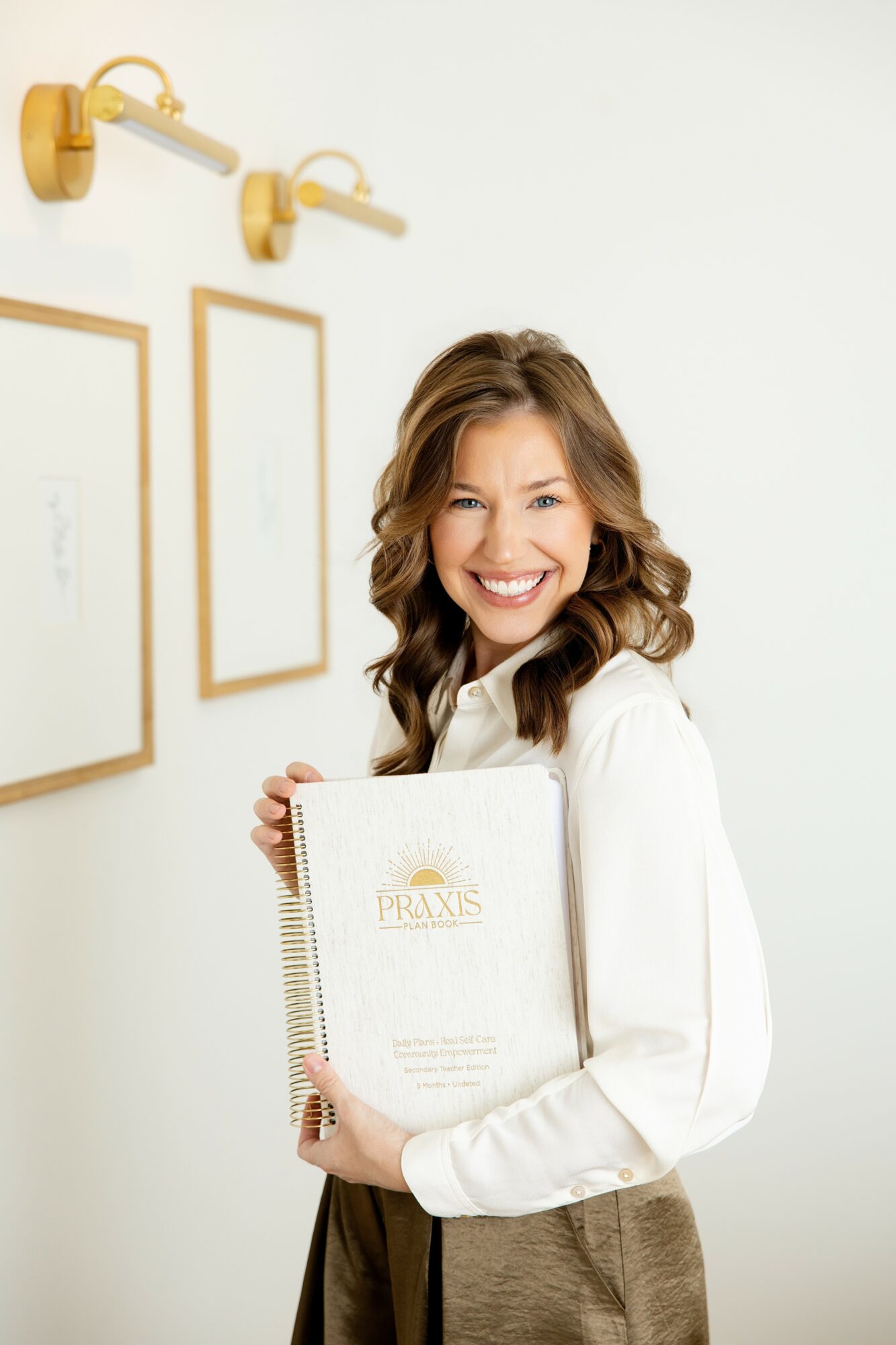
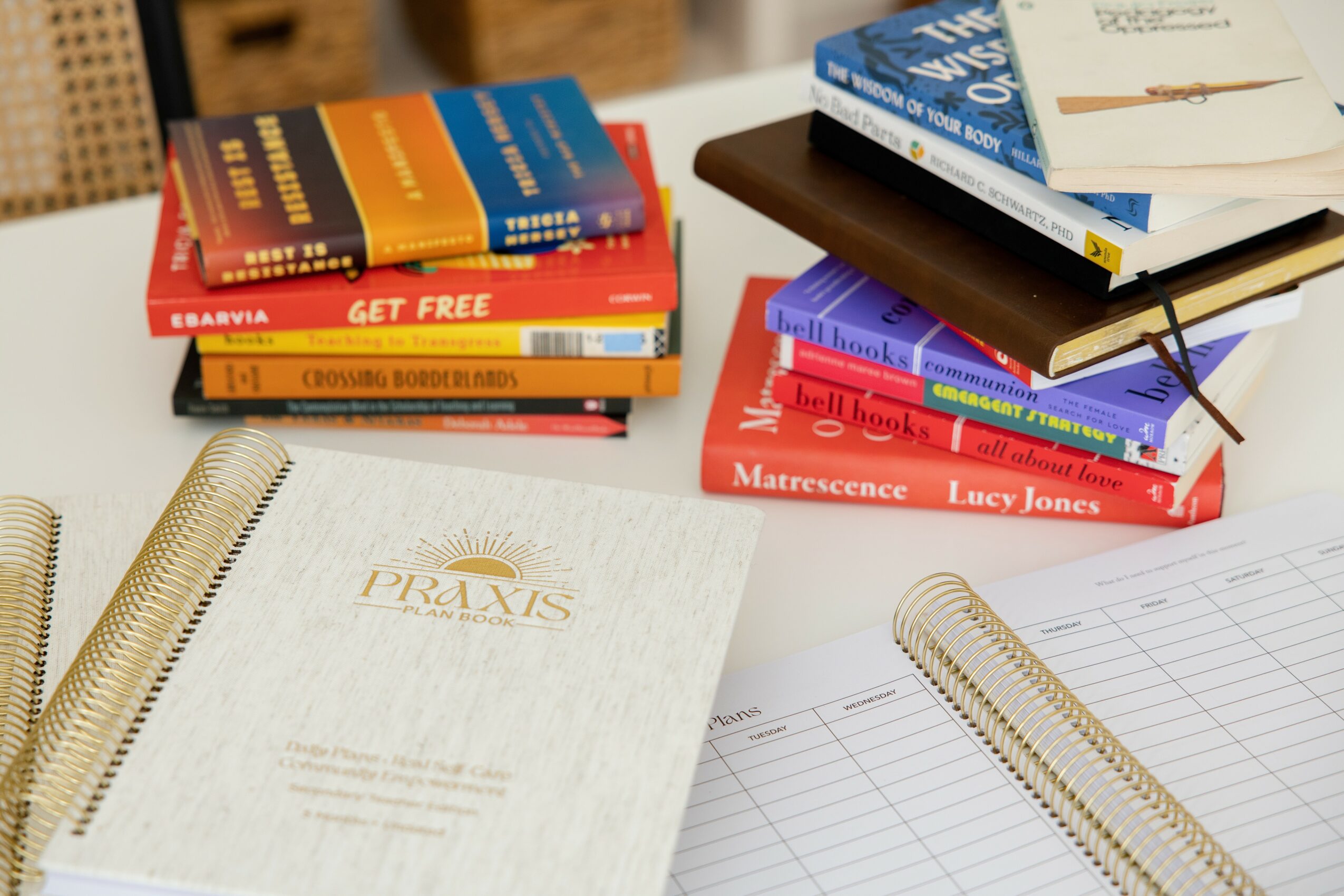
My Praxis Plan Book also serves as a powerful entry point into this work. The planner was designed specifically for secondary educators who want their daily planning practice to support not just organization, but reflection, awareness, and meaningful action. In coaching, we often use the structure and philosophy of the Praxis Plan Book as a framework for thinking about teaching in a more intentional way. The goal is to help educators pause, notice patterns, clarify values, and translate those insights into practical choices in their classrooms. What begins as a planning tool becomes a kind of reflective practice that supports both personal wellbeing and thoughtful teaching.
For schools, districts, and conferences, I also offer group workshops that function beautifully as professional development. These sessions bring together mindfulness practices, reflective writing, and conversations about what it actually means to create humane and sustainable learning environments. Educators leave with concrete tools they can use immediately—ways to regulate their nervous systems during the school day, cultivate calmer and more connected classroom spaces, and reconnect with the deeper purpose that drew them to education in the first place.
What I love most about working with educators is witnessing the shift that happens when they are given real space to slow down, reflect, and listen to their own wisdom. When teachers feel grounded, creative, and supported, that energy naturally ripples to students and their communities. In that sense, this work is not just about individual wellbeing. It is about imagining and building healthier educational cultures together.
Finally, I lead lunchtime community guided meditation circles at Thrive Holistic Co-Working Community in Glen Carbon, IL. Thrive is currently undergoing renovations and will be opening up in the Spring of 2026. As the Creative Director of this space, I am so honored to be a part of building this community space that reimagines how we work and create together. At Thrive, wellbeing is the foundation and center point for work, rather than something to push to the margins of your day. Come co-work and meditate with me here!
Contact Info:
- Website: https://enterpeace.co/
- Instagram: @enter.peace
- Facebook: https://www.facebook.com/61564006887609/photos/
- Youtube: https://www.youtube.com/@enterpeacecollective