


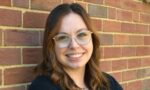
 Today we’d like to introduce you to Lisa Hilton.
Alright, so thank you so much for sharing your story and insight with our readers. To kick things off, can you tell us a bit about how you got started?
I have been compelled to create in a visually artistic way since as far back as I can remember. My journey to becoming a clay sculptor has been long and circuitous. Because I was good at math and the career path was very clear, I studied and worked in the actuarial field. That choice, although gratifying on many levels, didn’t address an unarticulated, deep-seated need. When my husband and I decided to start our family, I threw all my energy into parenting and domestic endeavors.
During my children’s high school years, I returned to college and earned my BFA. Touching clay felt like coming home. Although I enjoyed all the other mediums, I felt a different connection to the clay. Its various stages of development provide an endless array of challenges.
Would you say it’s been a smooth road, and if not, what are some of the biggest challenges you’ve faced along the way?
I believe that all people experience struggles as they embark on a career. A middle-age career change is no different in this respect. I often wish for twenty or thirty years of knowledge about clay so that I could avoid mistakes. Aside from medium-based knowledge, I have struggled with self-confidence and conflicting attitudes. I have also been challenged by the transition to the technology surrounding words, images, and social media as opposed to numbers and spreadsheets. I am continually evaluating the most effective means for marketing my work. Is it art fairs, galleries, online, or a combination of all of those? However, I know that overcoming these struggles is vital to the process of my career change. I believe I learn more from my mistakes and challenges than from my successes.
The struggles I encountered pale in comparison to my blessings. I embarked on this journey with the luxury of a support system for my education and development. My husband, family, friends, professors, and artistic community have encouraged me in meaningful ways. Collectors and art patrons bring their unique perspectives to my work and the validation that I welcome.
Thanks for sharing that. So, maybe next you can tell us a bit more about your work?
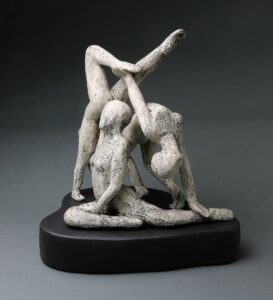
I am a figurative sculptor working in clay with a focus on gesture and texture. My current work is based on relationships with self and others. Each of us must balance our needs with those of our partners, families, co-workers, and communities to find a healthy, workable sense of equilibrium. Finding balance in life is an ever-changing and often elusive quest as we are filled with personal desires, hopes, dreams, and goals that may or may not be aligned with the people or events we experience. Striving for a life lived in harmony with others while honoring our own agenda is always a work in progress.
Exercise, dance, and yoga have always been a part of my life. I am drawn to the amazing abilities of the body. For me, the idea of finding equilibrium in life found a natural parallel in the balance needed for the physical demands of these pursuits.
As a sculptor, I am drawn to texture. I process much of my world through touch. I love finding new and different methods of creating surface variation. For me, texture is an expressive avenue for depicting the layers of complexity inherent in every person and provides an additional means for the viewer to add context.
One of the alluring ideas of working with the human form is the impact that gesture has on a viewer’s perception. The slightest tilt of the head, drop of the shoulder, angle of the hand, or tilt of a hip may create different implications for different observers.
My sculptures are built hollow from small slab parts that are pieced together. I refine each work with additive and reductive alterations. Because I do not utilize an armature, I must be careful to support the piece during drying and firing to control large cracks, loss of parts, and warping in undesired ways. As protection against these challenges, I form clay supports that are discarded when firing is complete. After the bisque firing to 1,850° F, a variety of finishes are applied. After the application of each finish, the piece is fired again, usually to 2,170° F. It takes an average of four firings to achieve the final outcome. I believe that a focus on the medium with an eye toward experimentation is essential in the process of my work. I am continually learning from the clay.
Before we let you go, we’ve got to ask if you have any advice for those who are just starting out?
I would encourage anyone, not just artists, to learn the value of receiving constructive criticism with an open mind. Understanding how to process and apply constructive observations and suggestions while maintaining the integrity of your personal process can often lead to new ideas or directions. I believe this advice applies to any career or personal pursuit. However, you know yourself and your work better than anyone. Understanding how to process and apply constructive criticism is also necessary.
I also believe it is important to connect with a community that can provide support. I belong to several local art and ceramic organizations. I have met many colleagues that are great resources on so many levels.
Being an artist is being a small business owner. Although I want to spend all my time in the studio, I spend almost an equal amount on the business end. As your educating yourself on your art, also learn business and marketing skills. Create a schedule that works for both studio and office needs.
Contact Info:
- Email: LrHilton@gmail.com
- Website: https://www.lisahiltonart.com
- Instagram: https://www.instagram.com/lisahiltonart/
- Facebook: https://www.facebook.com/LisaHiltonArt/





Sue Cosentino
September 7, 2021 at 6:30 pm
Lisa is an amazingly talented human. Her creativity and tenacity is immeasurable.
This is a great article. Interesting questions and very thoughtful answers.