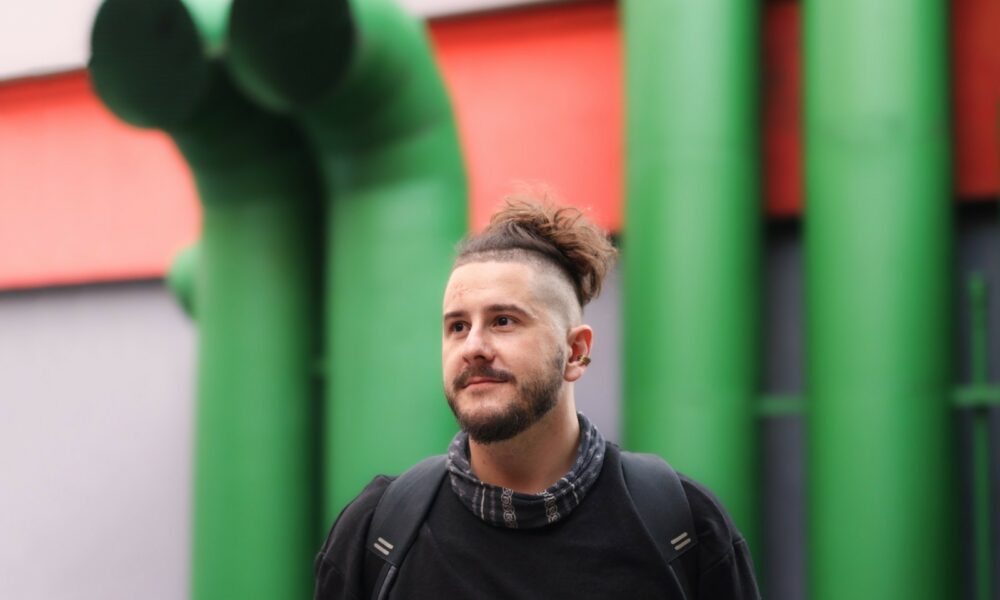
Today we’d like to introduce you to Nikola Lero.
Hi Nikola, thanks for sharing your story with us. To start, you could tell our readers some of your backstories.
My name is Nikola, but my colleagues call me Lero. I am a Bosnian-born poet, researcher, and activist. But, I usually describe myself using Walt Whitman’s words: “I am large. I contain multitudes”. And I am not unique in that. We all are mosaics, variations of multiplicities of identities we carry within.
My story started around three decades ago. I was born in the winter of 1991 in Sarajevo. Three months after my birth, the war in SFR Yugoslavia began to, and my family fled our hometown in central Bosnia. We wandered as refugees all over the region for years. In 1998, we resettled in an improvised refugee village in northeast Bosnia. Although we still had the status of refugees, life was becoming partially “normal.” Surrounded by books, which is not surprising as my father is a professor of Yugoslavian literature, I developed a love for reading and knowledge. I excelled at school, helped my peers in the community, and started playing piano and writing essays. However, I graduated in Law, as my parents expected from me. After that, I created my mosaic and started engaging in writing and digital media, becoming a journalist and working for UNICEF and the European Parliament in Brussels. Oh, yeah, I also worked as a DJ one summer in Croatia, in Istria. I loved it. Yet, after all these career adventures, I returned to my first love – knowledge and completed with honors my master’s program in Migration and Intercultural Relations in Germany, Norway, and Slovenia. That was a life-changing journey, for sure.
At the moment, I usually combine my creative and academic sides, creating assemblages that develop into projects like my book “47 poems about love pain and Bosnia”, the grassroots arts collective “Blank Pages” which I co-founded in Germany, or the queer literary literature collective “The Literature Union” in SouthEast Europe, where I am both author and editor. We will see where this road takes me next.
But I believe my entire life story can fit in a 6-line Instagram poem I wrote a couple of years ago:
“I am not afraid of anything anymore.
I have nothing to lose.
In my dreams
The rainforests of Amazonia grow
In my eyes
The peace springs.”
Would you say it’s been a smooth road, and if not, what are some of the biggest challenges you’ve faced along the way?
Growing up as kid refugee was not easy. When the war started, my parents lost the apartment they had just bought, their jobs, and their friends and family. We were on the move for ten years, often changing cities, even countries, overnight. That affects you. At least it affected me. First, you need a home to be at or to return to. And home is something we all need. It is the focal point, everyday life’s first and last coordinate. Second, as a displaced person, you often need more basic resources. I remember doing homework with candlelight as we did not have electricity for some time. Due to massive inflation after the war, we often needed more money for clothes or books. Luckily, there was always someone willing to help, to share.
Still, my family and I would face everyday discrimination, whether at a school where I went, at my father’s job, or by locals in an improvised refugee settlement where we were for years. Growing up like that, you start losing yourself a bit. Your identity becomes fractured, scattered over every place you have ever been, dispersed among communities that were never truly yours, no matter how much you would like that to be different.
Unlike Aleksandar Hemon, who in his Lazarus Project says, “Sarajevo is home, Chicago is home,” expressing his belonging to multiple places, the already loosely connected mosaic of my identity started to nomadically dissolve, forcing me to pose the crucial question – Where do I belong?
This pursuit of belonging is something that still follows me. This challenge of finding ways to belong is something that motivates me to continue my community-oriented work. Because once you become a refugee, you stay a refugee forever. A change of legal status does not imply a change of the other; way more important – an emotional one. Still, besides all the struggles and discrimination I went through, what kept me going were exactly a couple of people who would be there to help in any way – maybe just by showing they care, by sharing their coffee with you, their smile, their frequencies of love.
Thanks – so, what else should our readers know about your work and what you’re currently focused on?
My work is a melange of creative writing, community-building, and research. There are no lines between them. They form a unit. And that is my approach to my work – holistic. So, in every sphere, I incorporate the other ones. For instance, I work as a Fulbright researcher at St. Louis University, studying second-generation Bosnian Americans. But I also want to give back to those I engage with. Therefore, I am organizing creative writing workshops for migrant-background communities on the topics of Identity, Culture, and Home in the St. Louis area as a part of my Humanity in Action Alfred Landecker Foundation Fellowship on digital democracy. And that is my current focus.
Three workshops named “Poetry of Belonging” have already been completed. The first two occurred at St. Louis University in collaboration with the SGA Committee of International Affairs. The third one was at Thomas Dunn Learning Center last week, led by Anna Ojascastro Guzon, founder, and programming director at YourWordsSTL. Anna will also coordinate the workshop on May 6th. If you are interested, shoot me an email at lero.nikola1991@gmail.com.
And I am happy to share there will be two more! The next one is on April 17th at Atlas Week – one of the most significant and relevant events on cultural diversity, activism, and global citizenship in St. Louis. The theme for Atlas Week 2023 is “Chasing the Fading Echoes of Freedom in the 21st Century” and focuses on how freedom has been given, taken, or disrupted in recent years worldwide. And for those with migrant experience, pursuing freedom is one of the focal topics of their lives. Finally, the last workshop will occur in collaboration with STL Balkan American Connection, designed explicitly for Bosnians in St. Louis. The end product of all these workshops will be a TikTok poetry collection and an e-book titled “Poetry of Belonging .” And that is where we come from to my big mission.
My big mission and vision are to transform digital spaces into spaces of diversity, art, and creativity where everyone can express themselves without any negative consequences. Without hate. Without misinformation. With peace. And that is also my intent as UNESCO’s Youth Champion for Peace in a global UN initiative, “Social Media for Peace.” There is a need for every one of us to counter hate speech and polarization online. I do that via audio-visual poetic fragments on Instagram and soon TikTok, promoting cohesion, collaboration, and cooperation among diverse groups. Because, in the end, that is what we, as individuals but also as a society, should strive for. And what better tool for that than poetry?
Where we are in life is often partly because of others. Who/what else deserves credit for how your story turned out?
- The team of Humanity in Action and Alfred Landecker Foundation
- Anna Ojascastro Guzon – a poet and founder of YourWordsSTL
- Nikolay Remizov, SGA VP of International Affairs
- Hisako Matsuo – my supervisor and Prof. at St. Louis University
- Luella Loseille – Director of Atlas Program, St. Louis University
- Asmira Alagic – Saint Louis Balkan American Connection
Contact Info:
- Website: https://humanityinaction.org/person/nikola-lero/
- Instagram: https://www.instagram.com/lero.nikola/
- Facebook: https://www.facebook.com/
- Youtube: https://www.youtube.com/watch?v=fT4nJnbin7w
- Other: https://www.tiktok.com/@poetryofbelonging?lang=en