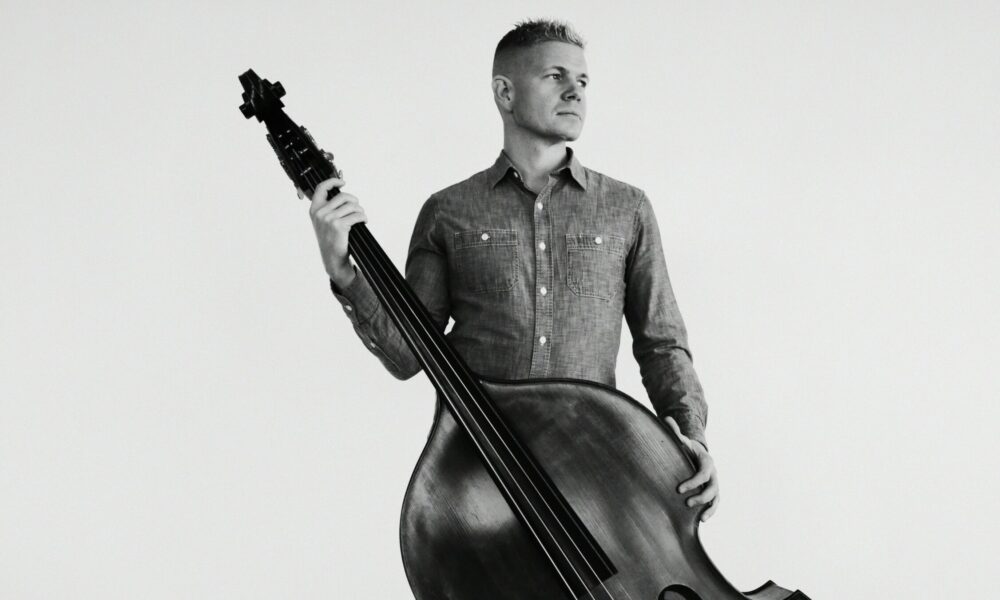
Today we’d like to introduce you to Daniel Loomis.
Daniel, we appreciate you taking the time to share your story with us today. Where does your story begin?
I grew up in St. Louis playing bass in the local jazz scene. I started playing guitar actually in high school and was quickly recruited to play bass in the school band with the understanding that if I could learn to play bass well enough, then I could train my replacement. Then my replacement would play bass in the jazz band and I could go back to guitar, which was always my goal. So, I learned to play bass, and I practiced and practiced. But by the time I was good enough to nominate my replacement I was in love with playing bass. And I was already getting gigs around town. In high school, I started playing gigs around town with my friends and with some the more experienced local professionals. Then I enrolled in school at Southern Illinois University at Edwardsville. I had two amazing mentors there – Reggie Thomas and Rick Haydon, among many other amazing teachers — my bass professor with the incredible Tom Kennedy. I learned so much at SIUE but was also really busy playing a lot of gigs around town, playing in a lot of bands, jazz gigs, and lots of weddings playing rock, funk, and pop.
That was all very inspiring, and when it came time for me to figure out my next move, I was not so excited about doing more school. However, I had recently met the bass professor from Eastman School of Music, Jeff Campbell. My mentor Reggie Thomas, from SIUE, had taken me to the Birch Creek Jazz camp to be a teaching assistant, and the head of that program was Jeff Campbell, who was then the bass professor and is now the head of the program at the Eastman School of Music. Jeff invited my to come and audition at Eastman. Eastman is a fantastic, very prestigious school, so I was obviously excited to even be considered there. I auditioned and was offered a scholarship.
So, I ended up going to Eastman School of Music and was really inspired by the scene there and the crazy diversity of music that I was exposed to. At SIUE, I was really focused on becoming a really good, functional bass player – having a good sound, good time, good feel – becoming a really strong, employable bass player. At Eastman School of Music people were playing all kinds of wild different art musics and taking all kinds of ethnic music from around the world and incorporating it into jazz. They were just involved in a whole range of creative things. So being part of that scene for two years that really opened my ears and horizons.
Then I moved to New York – and there those two worlds of education served me really well. Having a strong sound and groove enabled me to work a lot and get in a lot of professional situations right away. And having the expansive view that I got in Eastman allowed to get involved in wide variety of creative ensembles and situations.
So, I spent about 10 years in the New York scene playing as a sideman – playing in all kinds of different groups. A lot of more working jazz groups but also a lot forward-looking, progressive ensembles… having to deal with very challenging music as a bass player and bring my training as a strong groove player but also bring this creative, expansive approach.
And then for the last several years, I have really focused on my artistic development as a composer and a band leader. I always wrote music and led bands. Coming out of Eastman, I was already leading a quartet that released two albums and toured a lot across the US. I continued leading bands through the years, but in the last several years have really doubled down on creating and promoting my own projects and have tried to develop a fresh approach to presenting music in a way that can highlight a cause of activism or a story. I did an album called “Job’s Trials: A Jazz Song Cycle” which tells the ancient, Biblical story of Job — which I interpret as a parable of effective rebellion or resistance. A big part of that album was figuring out a way to incorporate a theatrical element – I wrote a libretto for a narrator to carry the story through the performance. So that was a new medium of theater combined with music in a novel way. So, I am now developing that format of theater/spoken word/music to present a new project that I am working on called Revolutions to present the story of the Haitian Revolution and the Spanish South American revolution under Simon Bolivar.
I am currently working on an even more expensive, avant-garde project called “Songs For the Mother Tree,” which will present the wisdom, community, and aptitudes of trees through music and theater. There is all this new research going on about trees, and I wrote this music as a response to it. I am working with the amazing theater director, Adrienne Kapstein to develop this hybrid format to present this trees project. So I guess my story is that I am coming from really loving jazz music and the art of playing the bass in a way that venerates and exalts the tradition of jazz to being more of a composer and a band leader – using that tradition of jazz to create a sacred, communal experience of music that brings us all together to talk about themes that are vitally important socially, spiritually or environmentally. To confront these themes directly – rather than more abstractly through instrumental music, like just naming piece after them – I want to get even more into the weeds. Talk about them more directly, to talk about the issues of how we talk about revolution or how we see our tree neighbors, or how we deal with rebellion.
Would you say it’s been a smooth road, and if not, what are some of the biggest challenges you’ve faced along the way?
There are obviously a lot artistic and logistical challenges to being a professional musician. Two challenges really come to mind though. One major challenge is the difficulty of getting traction and being able to survive in the New York scene. Just making enough money to get by. And also the difficulty of getting traction among so many other musicians who are doing incredible projects at a high level. I would say that that challenge always inspires you to be better. Because there are so many people doing really good work – it always inspires you to rise to that level and do the best work that you possibly can.
The other challenge is, as a bass player, so much of my attention for so long went to the craft of making the music as good as possible. My goal was, whatever situation I was in, I wanted to make my bass playing elevate that music as much as possible. So, the other challenge was breaking beyond that mindset and imagining what kind of music that I personally wanted to make. And thinking with a much scope about what was possible and thinking beyond my role as bass player. Thinking more broadly to what my training as a musician and my training as a jazz musician give to the music and to the art world in general. What can my background, insight, and artistry give to the world that will be exciting and essential?
Can you tell our readers more about what you do and what you think sets you apart from others?
My work now, I perceive in three major parts.
One is to continue to be very active as a bass player, playing bass with some incredible ensembles in the New York scene and beyond. For example, I player with the great saxophone player Joel Frahm, and his trio plays around the world. I play with my friend Dave Bixler in his Trio Incognito. I play in a group called Theodicy that I love. But just maintaining a high level of artistry and craftsmanship on the bass so that I can step in any situation and have the tone, time, groove, creativity, and fluidity to elevate that musical situation and bring the best of our everyone in that ensemble. That will always be an important part of my professional work.
I would say that the main thing that I am focused on now is my work as a composer and bandleader. I have four major projects that I am actively working on. I have Job’s Trials which is a project for two singers, guitar, bass, drums, and an actor in the role of Satan. That album came out in 2020 – we are touring with that project now. And I have an album coming out called REVOLUTIONS, which is a jazz quartet and a narrator who is using this theatrical/musical hybrid to portray the story of the Haitian and Spanish South American revolutions. Which I view as an important message to North Americans. We North Americans tend to venerate our American revolution as the revolution that truly embodies freedom and equality, and I think that it’s important for us to realize, as North Americans, that there are these revolutions right on our doorstep which did a much better job of truly fighting for freedom and equality than we did. And I think that we should always be cognizant of that and do whatever to we can to elevate those people and elevate those stories.
Then there’s a new music and theater project called “Songs for the Mother Tree” – looking into the inner lives of trees with personal and evocative music. I also have a new trio called the Mycelium Trio with two of my musical heroes, Adam Levy and Tony Mason. Mycelium are the underground fungal threads that connects all tree root systems. So, all of the root systems in a forest are connected by these fungal threads which run between all the trees and transfer information, resources, nutrients, carbon between all the trees and act as a network. That band is a little more like a typical jazz trio in the sense that it’s not a theater/music hybrid concert experience. It is more like a typical band that you would hear in a club.
So those are the four projects that I am working on as a composer and bandleader. I have one recent album out, “Job’s Trials” with that set of music. The rest of those projects will all be released on albums, hopefully within the next four years. Revolutions is coming out this year. “Songs for the Mother Tree” will hopefully be finished in about two years, and then the Mycelium Trio soon after that. So that’s my main work.
And then the other part of my work, which is really important to me, also is being a teacher. I keep an active and large studio of private students in New York. I teach a lot of different students at all different levels. I really love the practice of passing on what I am passionate about to the students in the next generation and thinking about what’s important to me in music, and thinking about how I can pass that love of music on my students.
We all have a different way of looking at and defining success. How do you define success?
Of course, I think that my defining success is yet to come because I am also striving towards the next big achievement. But I would look at two things that I am really proud of.
One is producing and releasing the “Job’s Trials” album. Because I worked on that music and album for 10 years. And it was very different kind of concept and musical experience than anything that I had seen before. So, there was no road map for what to do or how to put it together. I couldn’t just plug into another formula for how to make it happen. I had to really make it myself piece by piece. So, I was really proud of how it came out … I loved how the music came together. I love how the performance experience and the album experience with the theatrical element all worked together. It was truly gratifying doing the live performances, how people would come back to me after the performance and say the performance was a touchstone for them to have further conversation. That they then went home with their families and talked about standing up to injustice in society or how one can really make a change in the world. Or just talked with their families and their friends about important issues. And I was really happy to hear that the performance of “Job’s Trials,” my piece, had inspired those questions and conversations.
Also, I’m very gratified with “Job’s Trials”; after playing this piece for 10 years, the music continues to evolve. And what it means to me — the message of the music — continues to evolve. The art that I love is big enough that you can come to it over many years and get a different lesson or meaning from it every time. At least for me personally, I feel that with “Job’s Trials.” And I hope that other people will feel it too. But I think that if I feel it – and as an artist, I’m always very critical of my own work – that maybe other people can too.
The other thing that I’m really proud of as a defining success was the my performance at the Village Vanguard with my friend Vadim Neselovskyi. I played with Vadim in his trio for many, many years. He is an amazing composer and pianist — and a demanding, rigorous bandleader. We always tried our best to give our best at every performance. And we worked really, really hard to give an amazing performance at the Village Vanguard (which is certainly the best jazz club in New York, which probably means it’s the best jazz club in the world), and I think we really did. To get to play, there was a huge honor. So, I’m very proud of that performance.
And… a few very exciting things coming up in the near future….
REVOLUTIONS will be coming out in the near future. This project is music for a jazz quartet and a spoken word artist, portraying the Haitian Revolution, which I think is the most important revolution of our hemisphere — of North and South America, in terms of equality. And also the Spanish South American revolution, which I think of as a sister revolution to the Haitian Revolution. So that will be coming out in the fall — look out for it!
Also, for my St. Louis readers, I will be performing on June 10th with the St. Louis Jazz Edge Orchestra. I am coming back to my hometown in St. Louis and performing. We are doing a “Tribute to Bassists.” Many of the bassists to have come out of the St. Louis music scene are coming back/together to do a tribute concert to the iconic bassists Ray Brown, Charles Mingus, Ron Carter, and Jaco Pastorius. Should be an amazing evening!
Contact Info:
- Website: https://www.danloomismusic.com/
- Instagram: https://www.instagram.com/doomisbass/
- Facebook: https://www.facebook.com/doomisbass
- Twitter: https://twitter.com/doomisbass
- Youtube: https://www.youtube.com/@doomis1
- SoundCloud: https://danloomis.bandcamp.com/album/jobs-trials-a-jazz-song-cycle
- Other: https://danloomis.bandcamp.com/album/jobs-trials-a-jazz-song-cycle


Image Credits
Shervin Lainez