Today we’d like to introduce you to James Carlson.
Thank you so much for sharing your story and insight with our readers. To kick things off, how did you get started?
In my senior year at Concordia University in Seward, Nebraska, I switched my major from Social Work to Education. I needed to take additional courses to earn my degree and qualify as a teacher. To fill out the final semester, I could take an art class with Professor Reinhold Marxhausen, who had achieved national recognition for his pottery, mosaics, and object artwork. He was a real inspiration to me, so much so that I continued making pottery and entering my work into shows as a hobby. Upon graduation in 1971, I became a teacher at Immanuel Lutheran School in St. Charles. After a few years, I convinced the school board to invest in a kiln so I could share the joy of making pottery with the students. In 1999, I decided to return to Lindenwood University to get my master’s degree. Once again, I was fortunate to have an inspirational professor, Grant Hargate, who taught me more about the art of pottery. At that time, several fellow students and I learned about the Foundry Centre and its vision for showcasing the work of local artists. I was led by Christi and Tim Sawyer, a group of seven potters who rented space at the Foundry. I was one of them, and now the only one from the original group still at the Foundry. I have been fortunate to showcase my work in numerous shows and magazines.
You wouldn’t say it’s been obstacle-free, but so far would you say the journey has been smooth?
While my teaching and coaching duties were my priority, I also wanted to continue to work on earning my Master’s Degree and making pottery at the Foundry. My summers allowed me more time for that while also preparing for the school year ahead. The classes I needed for my degree were offered at different universities, such as Lindenwood, Webster U, and SIEU. There, I had the opportunity to meet talented artists and instructors who taught me to see new ways to look at ceramics. It was sometimes a struggle to fit it all in and a wonderful opportunity to widen my horizon.
One of my most memorable moments of inspirational impact, though, came from my students during a difficult time in my life when I was also dealing with the unexpected death of my brother. It was also around the period when an earthquake occurred in Japan, followed by a tsunami. My fifth-grade class and I talked about the problems Japan and its people were having, and my students felt they wanted to do something to help them.
One of my students asked me if they could make pottery and sell their work to friends, neighbors, and relatives to raise money for the Japanese people. We thought that was a good idea and agreed that their pottery work could only be done at recess. We set a goal of raising $100.00. They got busy and soon flew by their new goal of $200. Then the tornado in Joplin occurred, and the kids wanted to keep their charitable operation up and running. By the end of the school year, they raised $815.25 to donate to causes in both Japan and Missouri. It was a lot of work for them (and me), but our class’s charitable work was acknowledged with a great article in a Lutheran magazine. It was an experience that they would remember for the rest of their lives. They also learned (and I learned along with them) that even when sad events occur in the world (and our own lives), we can find joy and a feeling of accomplishment in helping others.
Thanks for sharing that. Can you tell us more about your work next?
Some of my former teachers had suggested having a plan before starting an art project, but that has never worked for me. I have a general idea and will work from there. If I make a mistake, I can go in a different direction. Most of my work develops as I work on it. For example, one of my students and I were working side by side on pottery wheels while I demonstrated various techniques for making a bowl. The piece she was working on got messed up, and she was frustrated. I suggested we trade places, I would work on fixing hers, and she could work on mine, and she agreed. While I could fix hers, unfortunately, she had some missteps with mine, which appeared unfixable. Later, to salvage the clay, I took the remains of the bowl off the wheel and began to weave it back together by using rolled coils to “sew” its parts back together again. After I finished it, I liked the combination of styles. Once the piece was fully glazed and sealed, I received numerous compliments and sold it to a customer later. The lesson I learned, which I now share with my students, is that you can take advantage of your mistakes to spur on your creativity to build something unique. My experience working with children reflects in my work, too, since it is often called “whimsical.” As a grade school teacher for over 43 years, I was always aware that I needed to make plans that would be doable for children by providing projects they would enjoy. I was always amazed at what they came up with to put their stamp on their work so it was appealing to themselves and one they could proudly show to others.
What makes you happy?
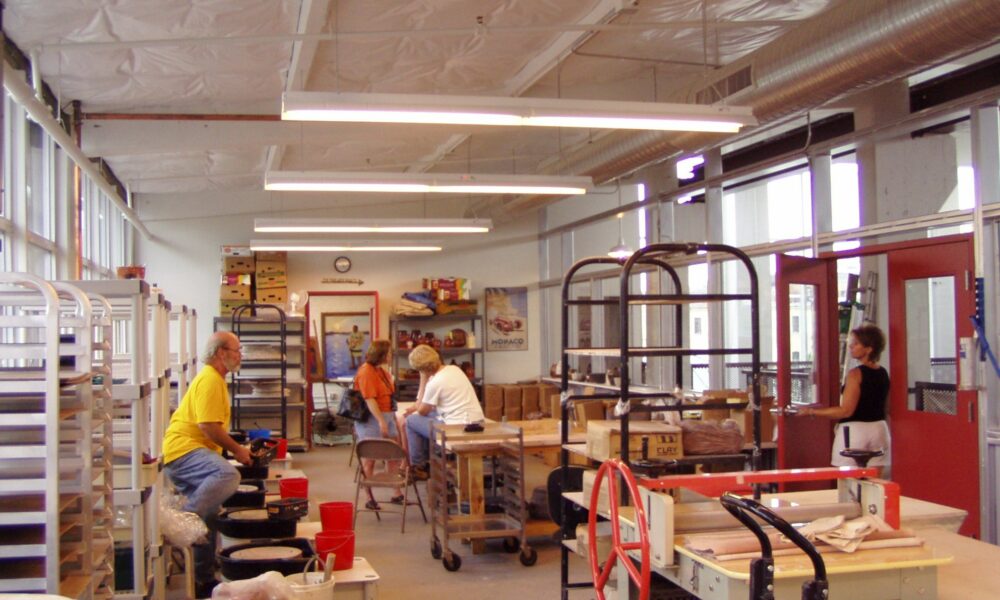
I have a studio at the Foundry Art Centre in St. Charles, MO. I spend time in my studio every day. The Foundry is open to either working on my art or giving classes to those who want to learn more about the artists themselves. Whether it is a visitor or a student, it is always fun to learn about others and their interests. As for myself, I am always trying to perfect the piece I am working on and often end up with many intricate details. I enjoy opening the kiln after my artwork is glazed and fired to see the result. I have that in ordinary with my students; we eagerly look forward to seeing the finished product of our creation. I often tell the people who come into my studio that they need to find a fun hobby/business they love after retirement. It keeps life exciting and fulfilling.


Image Credits
Brent Kuhlmann and The Foundry Art Centre