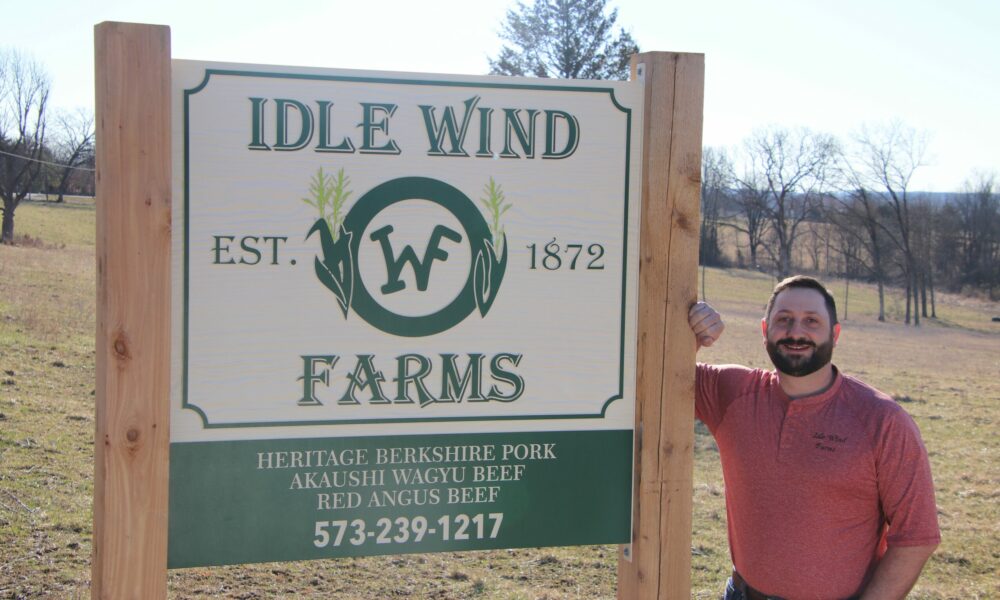
Today we’d like to introduce you to Ryan Dierking.
Hi Ryan, we’re thrilled to have a chance to learn your story today. So, before we get into specifics, maybe you can briefly walk us through how you got to where you are today?
Starting way back at the beginning our family farm was purchased back in 1872 and has been the place where 5 generations of my family were raised. I had been around farming in some capacity since I was born. I remember having baby calves in the garage to keep warm and having to give them bottles to keep them going.From this very young age, I had an affinity for being on the land and raising livestock, and a goal of one day operating our family farm. My family, before I was born, managed a diversified farm raising hogs, cattle, and some row crops. By the time I came around and could tag along with dad and grandpa the farm had started to change.Pigs were no longer part of the operation due to the 80s consolidation of the hog market due to the size of our farm, and the way we had raised hogs on the land. That was no longer a viable option. Additionally, the land we hold is not really suitable for large grain and row cropping like other parts of Missouri and the Midwest.
My grandfather and father decided to rent out what little grain fields we had for production and kept the cattle herd on the ground that was used for grazing. We had Hereford livestock and were crossing that with Black Angus to get what is known in the cattle industry as black baldies. Unfortunately, due to the carryover effects of the 80s farming financial crisis, we ended up having to sell part of the farm in the mid-90s.
That was a moment I remember vividly when my folks told me in 5th grade. My dad, Mike, at that point managed what he could while maintaining his off-the-farm job. I still loved bailing hay, driving tractors, and working cattle. I was able to show livestock at the Washington Town & Country Fair. It was one of the highlights of the summer each year.
As I progressed through high school, I knew that I wanted to pursue a career in production agriculture, but didn’t know what. I took a few trips to the University of Missouri at Columbia and then met Dr. Jerry Nelson who solidified my decision to attend MU and the College of Agriculture. At first, I thought I would be a plant breeder creator of ever higher-yielding varieties of our staple crops like corn or soybean, but after some time decided I would pursue a degree in agronomy and eventually pursued advanced degrees at Mizzou.
I entered into a master’s degree with Dr. Rob Kallenbach in 2006 and then furthered my education with Dr. Kallenbach with a joint program with the Noble Foundation in Ardmore, OK for a Ph.D. completing my doctorate degree in 2010. It was during that time in graduate school that my dad and I decided to take over the acres used for grain production we were renting out and convert the entire farm to perennial pastures and implement rotational grazing practices.
We purchased our first registered Red Angus cattle. We started with 10 and over the years replaced our Black Angus crossed cattle with the registered Red Angus cattle. We now are all Red Angus and run about 65 head of mama cows and raise about 40 head of feeder cattle that we sell direct sell to customers as well as sell registered breeding stock by raisings some bulls and our own replacement heifers.
Also, during that time my dad had the desire to raise hogs again; so I was able to track down some heritage Berkshire hogs from southern Missouri and dad purchased the first sow and boar to begin raising hogs again nearly 30 years after he and his father sold the last hogs off the farm. We now keep abounding 15 head of breeding stock and raise about 150-200 head of feeder pigs that we also sell either directly to customers or to a local co-op of producers that provides heritage pork raised on the land to restaurants across the US.
A recent addition just this past year in 2021 was the incorporation of some red wagyu cattle. I bought the first Akaushi wagyu cattle to our operation from Texas to improve some of our Red Angus beef cattle and to provide high-quality beef to supply to individual customers or restaurants in the Greater St. Louis area. I do all this with my folks Mike and Vickie along with my daughter Adalynn while I also work for an agricultural company Indigo Ag.
At Indigo I am the senior scientist working in regenerative agriculture working directly with growers across the US running our companies field experiments on how to best sequester carbon in the agricultural soils in the US and looking to the world as well. These experiments include studying the effects of tillage/no-till on the use of cover crops and manures while reducing inputs and how to best manage our nations pastures and grasslands to capture the most carbon as possible from grazing animals on the landscape
This also extends to integrating livestock in croplands where they can graze cover crops as well as determining the benefits of rotational grazing on the pastures and grasslands to capture the greatest amount of carbon possible and increase the resilience of our agricultural lands in the US.
Would you say it’s been a smooth road, and if not what are some of the biggest challenges you’ve faced along the way?
There have been several struggles; some of which I mentioned earlier with my grandfather having to sell part of the farm as part of the 80s when agriculture and family farms took some hard hits during that time.
Also, with my parents working off the farm for their day jobs all their life it was difficult to make any noticeable gains on the farming operation simply due to time restraints and the cost of running the farm. The high costs of a farming operation can be difficult to make ends meet sometimes but our love of the land and animal make it worth it. We love seeing the new calves and piglets born and providing for local families needs for high-quality protein as well as improving the land through the use of regenerative agriculture practices.
It is difficult to get a foothold in the business and get our family farm name out for people to know about us, but love sharing our passion for the land and animals with others. It is also difficult sometimes juggling my off farm job and handling the farm business. The farm never sleeps so to speak animals always need to be cared for. The bright spot is that there is never a dull moment.
As you know, we’re big fans of Idle Wind Farms. For our readers who might not be as familiar what can you tell them about the brand?
The name of our operation was serendipitously discovered by me and my Aunt Beth when we were looking up some of our family histories at the recorder of deeds in Franklin County. There we saw that the family farm was named over a century ago by our past family members as Idle Wind Farm.
To pay homage to my family roots we resurrected the name and currently market our farm products under that name. Since we raise livestock, Red Angus and now Akaushi ‘Red’ Wagyu and heritage Berkshire hogs we wanted to provide that same quality of products to families across East Central Missouri as well as the Greater St. Louis area. since about 2007 when we first started raising Registered cattle, we wanted to produce high-quality breeding stock to producers in MO and the region.
In order to do that we focused on using some of the best genetics and breeding stock we could find and selected traits that dealt with high-quality beef, namely marbling, which is the intramuscular fat that provides beef its juiciness and tenderness. We have sold several bulls and females, but not all animals are suitable for that market; however, they still produce high-quality beef and we want to share that.
Because we are a smaller operation, we don’t fit the current market paradigm well so we decided we would begin selling beef directly to customersThat part of our operation has started to blossom and we are continuing to build momentum as customers want to know where their food is raised and in a humane and ethical way. To have that direct connection with the producer they and reach out and talk with at any time. To further enhance our beef quality, we started crossing our Red Angus cattle with red wagyu, Akaushi, to provide an even high-quality product and are looking to begin offering that starting in the spring of 2023.
All our cows are rotationally grazed across our farm to keep the pastures and soils teeming with life of all forms. This has profound consequences on the ability of our land to produce forage for the cattle as well as keeping the agricultural land in great shape building soil organic matter; the lifeblood of soil. Our finishing cattle are provided with locally sourced grains as well as high-quality hay and/or forage depending on the time of the year. We strive to keep as much of our inputs local as we strive to provide our products to local
The same is true for our Heritage Berkshire pork. After purchasing our first animals we expanded that part of the operation and even brought in some genetics from England to get some of the best-sourced genetics from around the world; which I believe sets our Berkshire pork above and beyond other pork in the market. All of these animals are raised outdoors on pasture and dirt their entire lives and provide a high-quality diet of locally sourced corn.
We provide all these products on our online store which can be found on our farm website and are looking at other ways to provide these products to individuals and restaurants looking to provide a locally produced high-quality product to their families or patrons.
Do you have any memories from childhood that you can share with us?
Some of my favorite are times spent out on-farm walking in the pastures with the cattle, seeing new calves jumping around in the pastures, or taking walks with my family in the woods on the farm. I really enjoyed hunting with my dad or looking for morel mushrooms in the spring.
Every summer during school summer vacation I would spend time with my grandparents who lived in the farmhouse and just get to spend time with them. I can still smell my grandmother making fresh bread and then eating ice cream right out of the tub with my grandpa and realizing we had just eaten about half of the ice cream. I also like getting to explore the farm and the old machinery and looking for treasures that a little 8-year-old boy might find digging through the farm sheds. When I was in high school grandpa, dad and me worked on restoring the first and original John Deere unstyled A tractor that was purchased for the farm in 1929. It is still in the shed and we get it out from time to time just to hear it run. There is something special about spending time with family and the simple life we lived on the farm. I cherish those memories and look to provide those same experiences for my daughter with my parents and cousins.
Pricing:
- We sell beef whole, half, and a quarter for $4, $4.20, and $4.40 per pound.
- We sell pork whole half for $3 and $3.10 per pound.
- We also provide boxed beef and pork for specific prices found in our store.
- We sell individual cuts that consumers can pick and choose from on our farm store online.
Contact Info:
- Email: rdierking@idlewindfarmsmo.com
- Website: idlewindfarmsmo.com
- Instagram: https://www.instagram.com/idlewindfarms/
- Facebook: https://www.facebook.com/Idlewindfarms
- Other: https://marketwagon.com/vendor.php?id=6967


 Image Credits
Beth Dierking