Today we’d like to introduce you to Liana Tilton.
Hi Liana, can you start by introducing yourself? We’d love to learn more about how you got to where you are today.
It was my first week of college, and I was perusing the many booths at WashU’s student group fair. Although I was excited to join many sign-up lists, I knew I was on the lookout for a certain type of club: Robotics Club. I was unsuccessful and disappointed after an hour and many laps of the fair. My high school life revolved around my school’s robotics team. It was the source of my greatest memories and closest friends, and I wanted to find a similar community at WashU. My high school robotics friends now at other top universities were finding robotics clubs to join. I knew St. Louis had a growing tech startup community, so I was shocked that WashU didn’t have a robotics club. Throughout my first semester, I met many other students who felt the same way I did. We chose engineering because of our high school robotics club experiences and were sad that we couldn’t find something similar in college. So, I began playing around with the idea of starting a club. I had been captain of my high school team for two years and was always interested in entrepreneurship, so founding a robotics club seemed like a cool idea. I sent out a Google form to the engineering school that asked a single question: If there was a robotics club at WashU, would you join? I received over 100 Yes responses. I was genuinely shocked, which confirmed that 1) this was an idea worth exploring and 2) the demand for a club like this was high. Unfortunately, the pandemic hit, we were sent home, and I took a gap year. Although I was away from the school for a year, the idea never left my mind, and when I returned in the Fall of 2021, I got to work brainstorming.
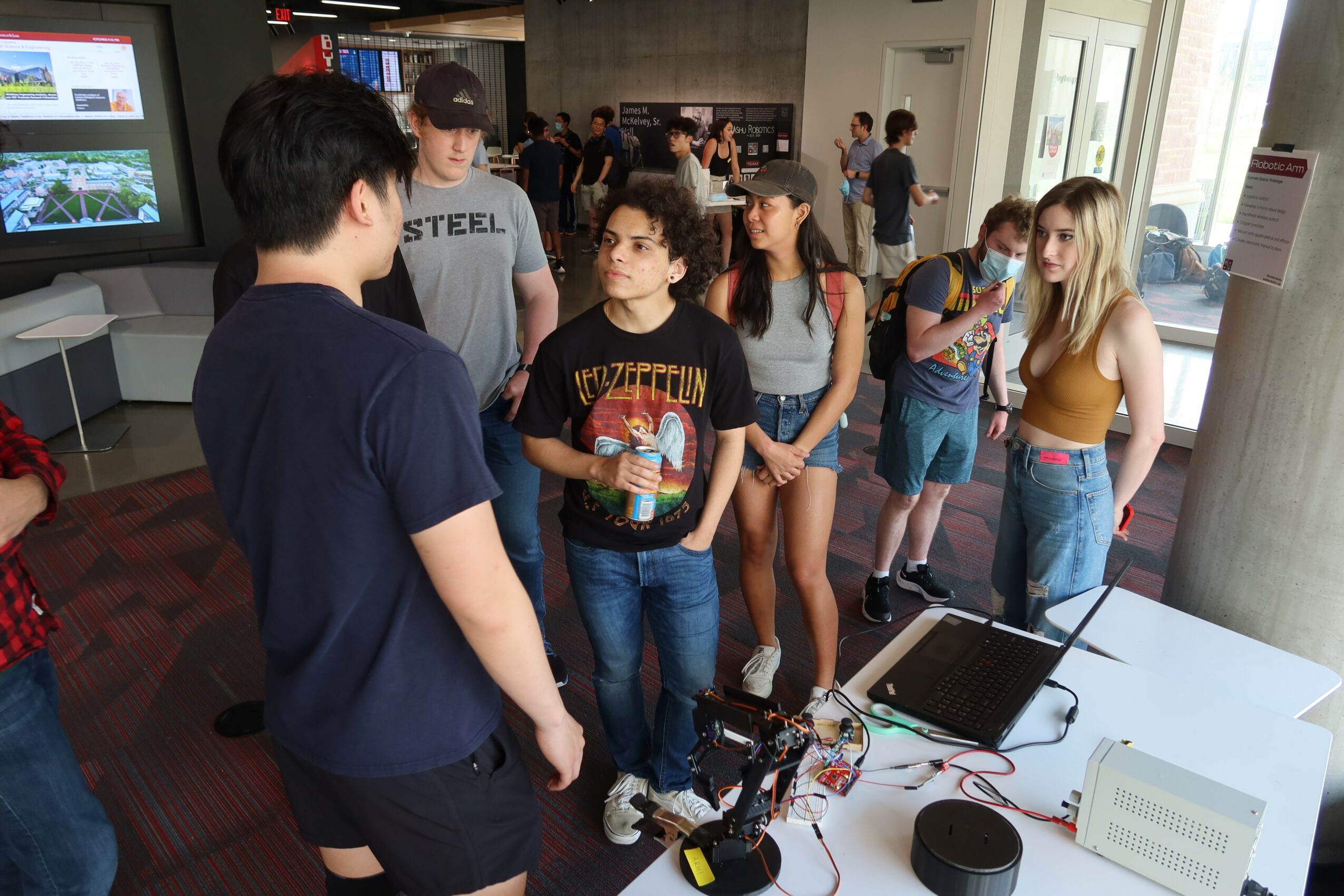
By December 2021, I found my team: the 1st WashU Robotics Club Executive Board. We were a strong group of 13, representing every undergraduate class and almost every engineering major. In January 2022, we officially launched the club. I knew we had lots of work to set up the club before opening to the entire student body, so the club remained a group of 13 for the first semester. Over the spring semester and the summer, we worked on three exciting robotics projects, became an official student group, and secured funding, resources, and support from the school. By the time the Fall 2022 semester started, we were ready to open the club to all, and we did just that. We grew our club to over 200 members, increased the number of projects to 6, began outreach initiatives, and made meaningful alums and industry connections. It’s so exciting to see that as we grow, we are starting to be known at WashU and beyond, and it feels perfect to see that the hard work is paying off.
Can you talk to us about the challenges and lessons you’ve learned along the way? Would you say it’s been easy or smooth in retrospect?
Starting an organization from the ground up was not easy, but the journey was made much smoother by the incredible support from the WashU McKelvey School of Engineering. One of the biggest hurdles was finding a space to call home. Space is a very limited commodity on campus, and building robots requires a decent amount. I remember going on my own WashU “tour,” checking each building floor in search of empty spaces. Many meetings and emails later, we found a great space in the new McKelvey Hall. We are incredibly thankful to Dean Aaron Bobick for playing a major role in finding us a space.
Can you tell our readers more about what you do and what you think sets you apart from others?
I’m a huge robotics nerd, and my passion for robotics goes beyond founding the WashU Robotics Club. I’m majoring in Electrical Engineering and minoring in Robotics. I’ve researched robotics at Yale and Stanford labs for about six years, and my all-time favorite movie character is Baymax from Big Hero 6.
What I find most exciting about robotics is that it is a highly collaborative field. Roboticists find creative ways to put together a wide range of engineering concepts and technology developed by all types of engineers: mechanical, electrical, computer, chemical, biomedical, etc. As an extroverted people-person, robotics allows me to apply my passion for engineering to exciting interdisciplinary projects and frequently collaborate with others.
I can’t mention my passion for robotics without pointing out one glaring hurdle in the field: it is dominated by men. I’ve gotten used to being one of the only women in the room, having mostly male professors, and searching hard for role models who look like me. I’ve been lucky to have some incredibly inspiring women engineers. I find it extremely important to serve as a role model to young girls by teaching robotics and STEM classes to elementary, middle, and high school students.
Who else deserves credit for your story?
I am incredibly grateful to everyone who has supported the club. We would truly not be here without everyone below:
- First and foremost, the WashU Robotics Club Executive Board. I would not have been able to get this club off the ground without the board, including my awesome vice presidents and friends: Jack Nanez ‘24, Max Saltrelli ‘25, and Matthew Tiemann ‘23.
- WashU McKelvey Engineering School and Dean Aaron Bobick have been incredibly supportive of us. Specifically, some amazing faculty:
– Our faculty advisor, Professor Yiannis Kantaros
– Our mentor Dr. Louis Woodhams
– Department chairs of MEMS and ESE, Professor Phil Bayly and Professor Bruno Sinopoli, respectively - I also thank our sponsors, and supporters, Stuart Bowers, the Hands-on Robotics team, and Dan Rosenstein (WashU ’99).
Contact Info:
- Website: washurobotics.com
- Instagram: instgram.com/washurobotics