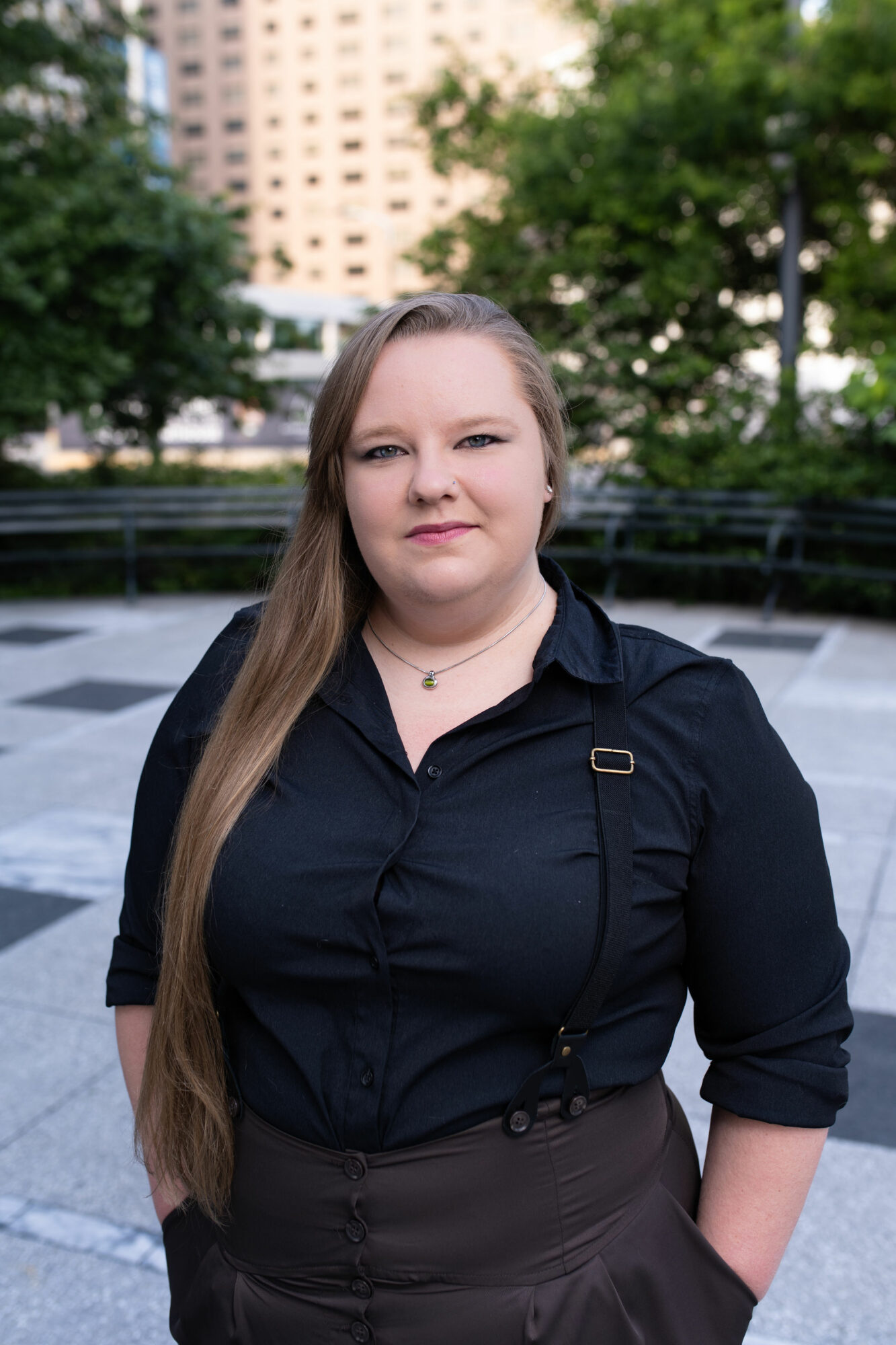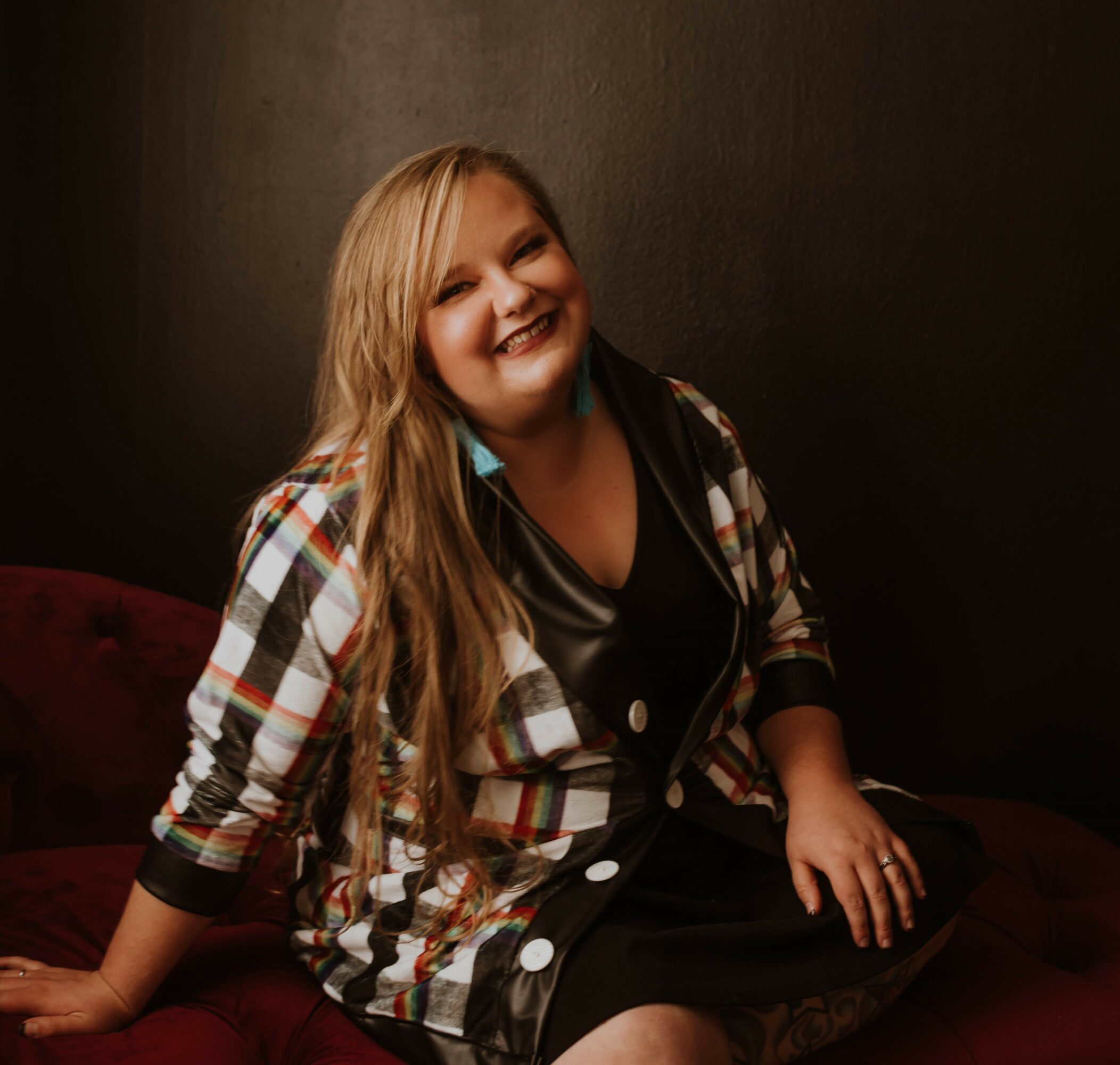
Today we’d like to introduce you to Amy Studer.
Alright, so thank you so much for sharing your story and insight with our readers. To kick things off, can you tell us a bit about how you got started?
As a Chicago-land transplant, I grew up with immediate access to a much larger city and a very different set of challenges. I’m the product of family-owned small businesses, both small-town and big-city resourcefulness, and a “fuck around and figure it out” mentality. Most of my family didn’t graduate high school, let alone college. I was voted least likely to go to college in both grade school and high school — and ended up the first person in my family to earn a bachelor’s degree, a master’s, and eventually a professional license.
Thanks to private religious schools that never assessed for learning differences — and a family who had no framework for understanding disability — my own disabilities went unnoticed for years. I didn’t learn what an educational accommodation was until my first full year of college. In a way, that experience became the backbone of my mission now: creating spaces where people don’t have to earn accessibility, understanding, or acceptance.
I was pushed into a “therapist role” long before I ever trained as one. I grew up in systems where being attuned, helpful, observant, and vigilant wasn’t optional — it was survival. I learned to read a room before I could articulate what I was sensing. I learned to advocate for others, soothe tension, carry responsibility, and make meaning out of chaos long before I had the language for any of it. Over time, those survival skills shifted from hypervigilance to intuition — from obligation to something purposeful, something I could use with consent and clarity rather than instinct alone.
Professionally, I grew up working within my family’s business, and I took on any job or volunteer role that allowed me to move toward my goals. From age 14 on, I worked three to four jobs at a time while going to school full-time. I started in disability supports as a babysitter for neurodivergent children, then as a personal aide for employers with mobility disabilities, and eventually into residential care for teens and adults. I also worked in higher education support roles, learning quickly how systems either empower people or quietly shut them out.
Before becoming fully licensed, I spent a decade with a well-renowned, Travel Channel–recommended production company and their haunted house — an unconventional training ground, but one that taught me more about misfits, the psychology of fear and anxiety, nonverbal communication, community, play, humor, gender performance, resilience, and teamwork than any graduate program ever could. That environment shaped my belief that people thrive when they’re allowed to express themselves without shame and when their differences are not just tolerated but valued.
Once I moved to St. Louis, I transitioned into ISL home management, inpatient treatment, PHP/IOP and after care programs, een behavioral health residential care, and community mental health. In every setting, I saw the same pattern: people were expected to “heal” without having access to food, safety, respect, or consistent support. Clients were often pathologized for using the very strategies that had kept them alive. It became clear to me that if healing was going to be real, it had to be accessible, identity-affirming, nonjudgmental, and grounded in the realities of someone’s lived experience. The staff hired on to support the most vulnerable were often those with the least amount of education, and forced into burn out long before they gained enough experience to thoroughly support those on their caseload.
That belief led me to build a practice rooted in the values that shaped me: honoring people’s full humanity, embracing sexuality and gender diversity, affirming neurodivergence and disability, and creating spaces where alternative relationships, identities, and expressions are understood rather than questioned.
My path has been a mix of clinical training, spiritual development, somatic work, liberation psychology, sex-positive frameworks, and a lot of unlearning. Today, my work centers on helping people reconnect with themselves in ways that feel safe, embodied, and sustainable. I don’t believe in “fixing” people — I believe in helping them understand the meaning behind their patterns so they can choose, with agency and compassion, what still fits who they’re becoming.
I’m sure it wasn’t obstacle-free, but would you say the journey has been fairly smooth so far?
No — and honestly, I don’t think it’s supposed to be. My road was a mix of trauma, caretaking, chronic pain, and learning how to build safety in places where there wasn’t any. I had to figure out how to be a person while constantly reading danger, supporting others, or picking up pieces no one else could hold.
Professionally, the obstacles were similar: broken systems, impossible caseloads, inaccessible policies, and environments where survival was prioritized over humanity. I’ve had to leave jobs because I couldn’t participate in systems that harmed the very people they claimed to serve.
Personally, I’ve done my own work — reclaiming my body after trauma, navigating dissociation, learning how to trust my intuition again, and figuring out how to let myself be held rather than always being the one who holds. None of this was linear.
But those challenges shaped how I practice now. They taught me that healing isn’t about perfection — it’s about choice, connection, and building a life you don’t have to constantly endure.
As you know, we’re big fans of Alternative Access Counseling. For our readers who might not be as familiar what can you tell them about the brand?
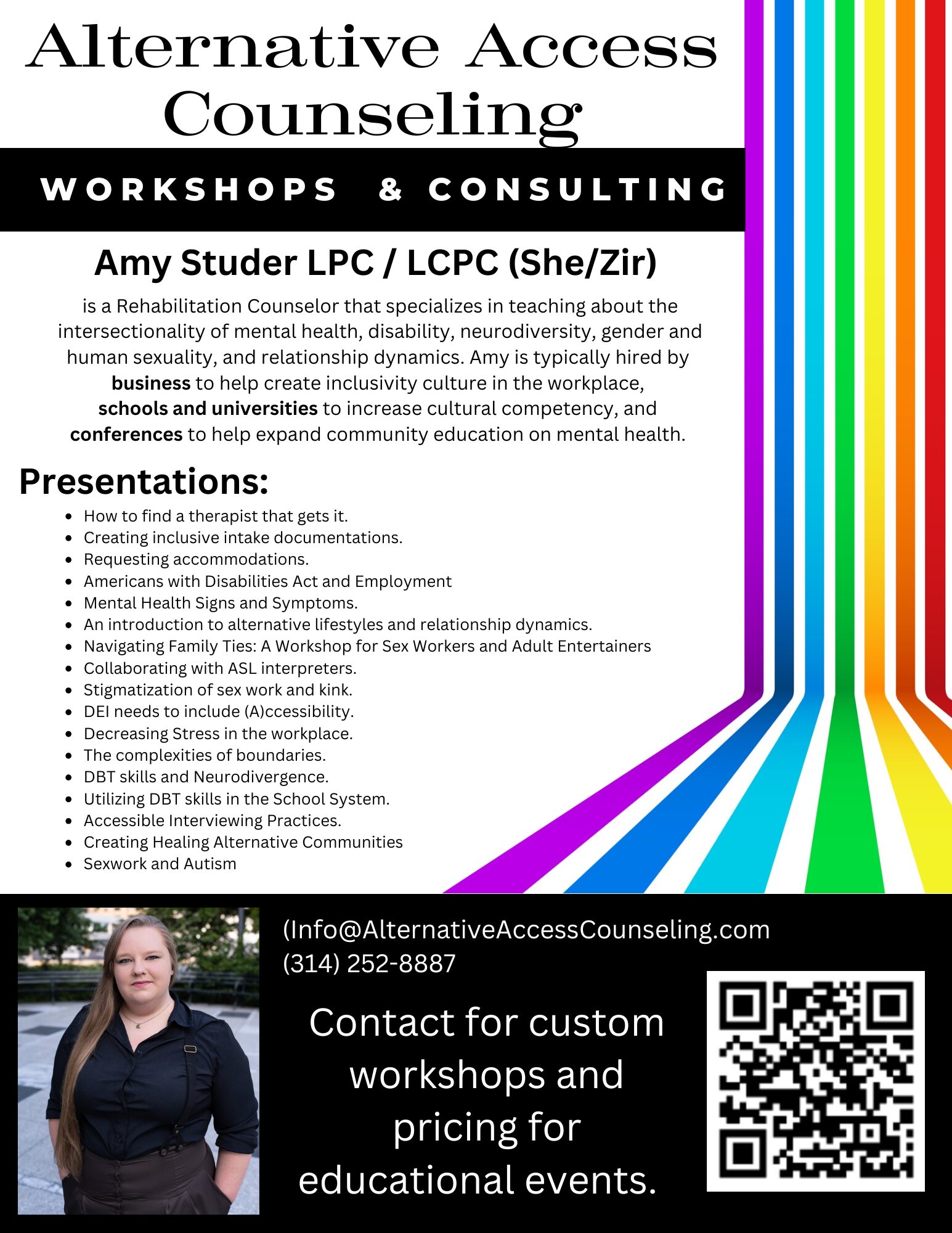
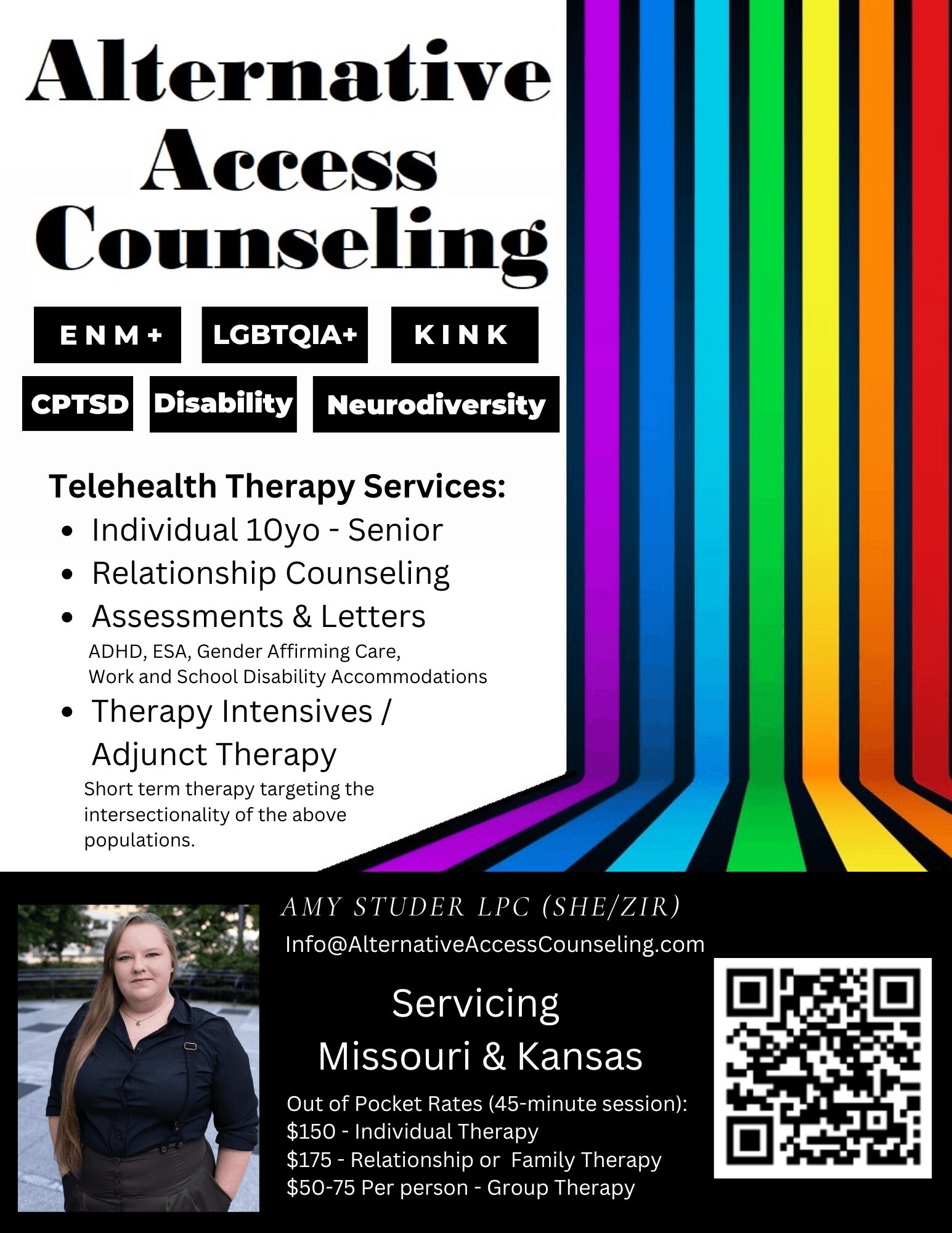
I run a therapy practice — Alternative Access Counseling — that centers on safety, consent, embodiment, and accessibility. My clients tend to be trauma survivors, neurodivergent folks, LGBTQIA+ clients, people who’ve lived inside systems that failed them, and anyone who’s learned to survive by disappearing parts of themselves.
What I specialize in:
trauma and dissociation
somatic and nervous-system-based healing
neurodivergent and disability-affirming therapy
gender-affirming and liberation-focused work
kink, adult entertainment, non-monogamous affirming a, consent-centered therapeutic spaces
existential and meaning-centered healing
What people often say sets me apart is the way I blend structure with humanity. I’m not a “fix you” therapist. I’m a “let’s understand why this makes sense, and then you decide what you want to do with it” therapist. I honor stimming, movement, pauses, cursing, dark humor, and the messy reality of being a person. I teach people how to identify their own values, unlearn societal pressures, set boundaries that reflect their lives, and show themselves the same human decency and respect that they bestow to others.
I’m most proud of the accessibility of my practice — not just the formal accommodations, but the relational ones: shared humanity, transparency, pacing with the nervous system, and meeting people where they truly are. My brand is built on radical respect, autonomy, and the belief that everyone deserves to exist without shrinking themselves first.
What do you like and dislike about the city?
What I love most about St. Louis is the community — people here are real. You get honesty, grit, humor, and connection without the pretense. We have a unique blend of cultures, art, activism, and neighborhoods that each have their own personality. There’s also something grounding about the way St. Louis holds both history and possibility at the same time.
It took me a while to understand the “where did you go to highschool?” question, and my answer of what I like the least originates there- the fragmentation. We’re a city that sometimes struggles under old systems, old narratives, and old wounds. Access isn’t the same for everyone, and the divide between resources and need can feel heavy. But I also think that’s why so many of us are here doing the work — because St. Louis has the potential to grow in ways based upon its values.
Pricing:
- $150- Individual counseling
- $175- Relationship and family counseling
- $50-75 – Group therapy session
- Limited sliding scale spots
- Intensive session and assessments (2-6 hour session) price available upon request.
Contact Info:
- Website: https://www.alternativeaccesscounseling.com/
- Facebook: https://www.facebook.com/AlternativeAccessCounseling
- LinkedIn: https://www.linkedin.com/in/amystuderlpc
- Instagram: https://www.instagram.com/alternativeaccesscounseling/