We recently had the chance to connect with Jeff Allen and have shared our conversation below.
Hi Jeff, thank you so much for taking time out of your busy day to share your story, experiences and insights with our readers. Let’s jump right in with an interesting one: What is a normal day like for you right now?
It’s hard to define a normal day, but I’ve found some steady rhythms. Most mornings start with my wife, my son, and me getting ready for the day. Preschool drop-off usually comes first, followed by a coffee and a mental reset before work begins. I’m a videographer for Easterseals Midwest, where I spend my time telling real stories about people with disabilities and the teams who support them. Some days I’m editing at my desk. Other days, I’m out in the community with a camera in my hand, trying to capture something honest and meaningful.
Technically, I work from home, though really I work from a rotating list of my favorite coffee shops around the Metro East and St. Louis. I’ve learned that a good cup of coffee and a change of scenery go a long way when you’re trying to stay creative and focused.
We live in Belleville, and I work throughout the St. Louis area, so I’m often in the car. That time has become important to me. I use it to think through ideas, prep for shoots, or just breathe a little before the next thing starts.
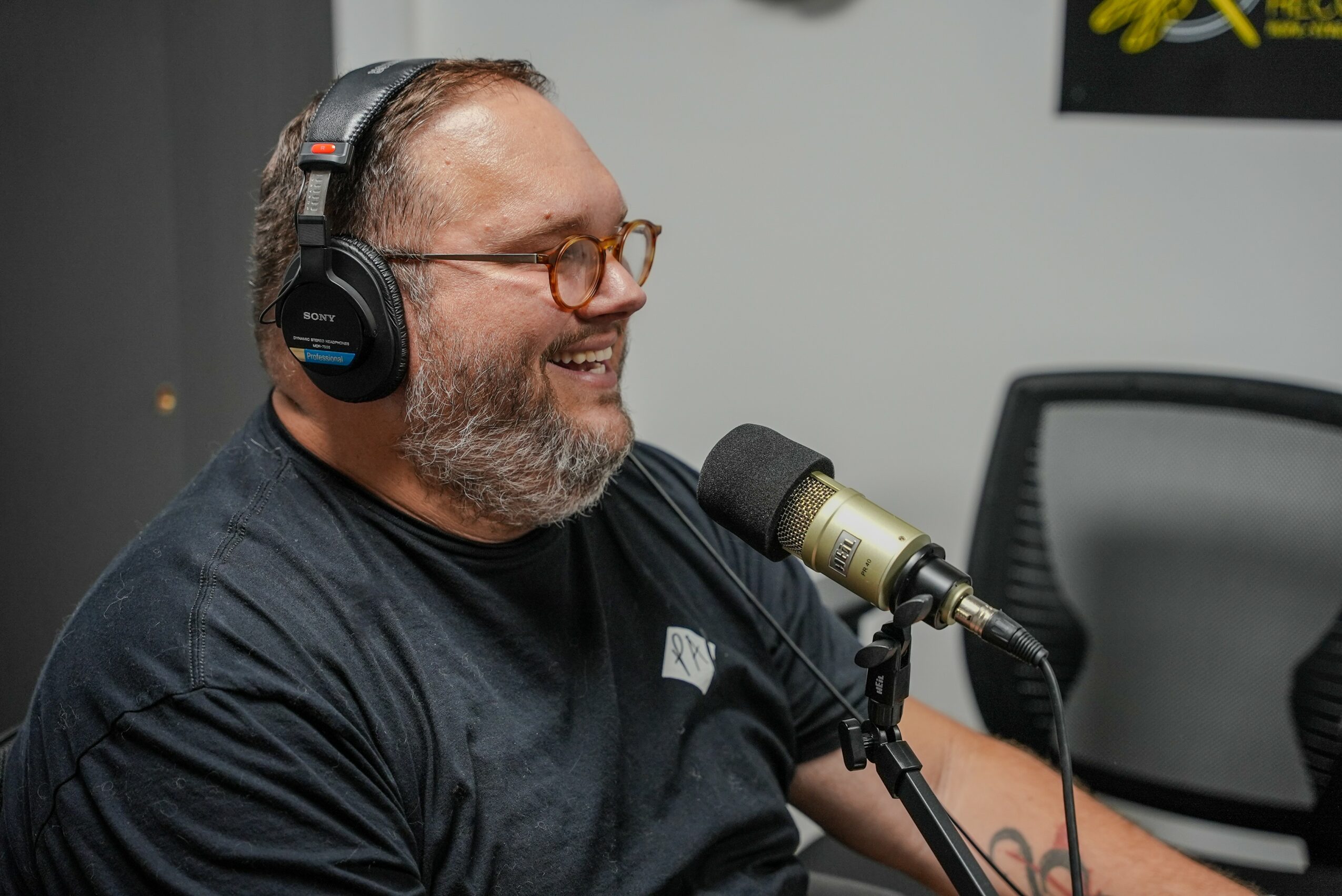
In the evenings, I switch gears and work on Pondoff’s Anonymous, a podcast I co-host that focuses on recovery and mental health. We record out of a small studio and bring on guests who have been through it. Some of the stories are tough, but they’re real, and they matter. What started as a side project has turned into a growing community that I’m proud to be part of.
In the middle of all of it, I do my best to show up as a husband, a dad, a friend, and a steady presence. Every day looks a little different, but I’m learning to stay grounded, stay creative, and keep moving forward.
Can you briefly introduce yourself and share what makes you or your brand unique?
My name is Jeff Allen. I’m a videographer, storyteller, and podcast producer living in Belleville, Illinois. I work with Easterseals Midwest, creating videos that highlight the lives and experiences of people with disabilities and the teams who support them. It’s not just content for the sake of content. These are real stories that deserve to be told with care and respect. That’s the heart of what I do.
Like I mentioned earlier, I also co-host Pondoff’s Anonymous, a recovery-focused podcast that’s grown into a much larger project than any of us expected. We have honest, sometimes unfiltered conversations about addiction, mental health, and what it looks like to keep going when life knocks you down. The podcast has brought in listeners from all over, and we’ve started building a real community around it. We’ve got merch, giveaways, live shows in the works, and sponsors who believe in what we’re doing.
What makes my work unique is the focus on authenticity. Whether I’m filming a family’s story for Easterseals or sitting in the podcast studio with a guest, I’m not interested in polish over truth. I care about making things that feel human and connected. I work from home, although most days you’ll find me tucked into the corner of a coffee shop somewhere in the Metro East or St. Louis, chasing that mix of caffeine and creative momentum.
Amazing, so let’s take a moment to go back in time. Who were you before the world told you who you had to be?
I was sensitive. Emotional. Curious. I was a kid who felt everything really deeply and had no idea that most people didn’t feel that way. I always had this sense that something was “off” about me, like I was just a little too much or not quite enough. I was good at blending in when I needed to, but I never really felt like I fit the mold. I learned how to be funny. I learned how to be useful. But I didn’t know how to be at peace.
For a long time, I thought I was just bad at regulating my emotions or not trying hard enough to be stable. I beat myself up a lot for that. I tried to power through. I tried to hide the lows and overcompensate during the highs. That worked for a while, but it took a toll.
It wasn’t until I was diagnosed with cyclothymia that everything clicked. It gave language to what I had lived with for years. It wasn’t just personality. It wasn’t just stress. There was something real happening in my brain that made life feel like a constant push and pull. And the moment I got that clarity, I started being able to show myself some compassion. That changed everything.
Before the world told me who I had to be, I was someone who felt things deeply and moved through life with a quiet intensity. Now I know that’s still who I am. The difference is, I’ve stopped trying to flatten it out or explain it away. I’ve started to work with it instead of against it. And that’s helped me be more fully myself — as a dad, as a creative, and as a human being trying to do some good while I’m here.
When did you stop hiding your pain and start using it as power?
For most of my life, I didn’t know what to call the thing that made me feel up and down so often. Some days I’d feel unstoppable, full of energy and ideas. Other days I could barely function, stuck in a fog I couldn’t explain. I thought I just had to push harder. I didn’t tell many people because I didn’t have the words for it. I assumed this was just who I was, someone too sensitive, too moody, too inconsistent.
All through my twenties and into my thirties, I was outspoken about mental health. I thought I had generalized anxiety disorder, so I leaned into being an advocate. I encouraged others to seek help, even while I was quietly battling something I didn’t fully understand in myself.
It wasn’t until recently that I learned I have cyclothymia, a mood disorder on the bipolar spectrum. Getting the right diagnosis changed everything. I started the right medication, I committed to talk therapy, and I finally stopped blaming myself for things that were never just about willpower. That shift gave me perspective, and it gave me compassion for myself in a way I had never known.
I don’t hide it anymore. I talk about it openly, I write about it, and I build stories that remind people they are not alone in their struggles. I co-host a podcast where honesty and vulnerability are at the center of every conversation. That’s how I use it now, not as something to be ashamed of but as a way to connect with others and hopefully help them feel less isolated.
Pain doesn’t disappear when you name it, but it becomes something you can work with. For me, it has become something useful, something that allows me to build connection. That, to me, is what power really looks like.
Alright, so if you are open to it, let’s explore some philosophical questions that touch on your values and worldview. What are the biggest lies your industry tells itself?
One of the biggest lies in video and media is that polish equals impact. There’s this idea that if something looks cinematic enough, or if you throw in slick graphics and a perfect script, then people will automatically connect to it. That just isn’t true. I’ve seen videos with huge budgets and flawless production that fall flat because they forgot the most important part: the human story.
The work I do has taught me that people respond to honesty. They respond to vulnerability. They respond to real faces and real voices, not just pretty edits. At Easterseals, the videos that make the biggest difference are the ones where families or individuals share their experiences in their own words, sometimes through tears, sometimes with laughter, always with heart. That connection goes deeper than any special effect could.
The same goes for podcasting. I co-host Pondoff’s Anonymous, and some of our most powerful episodes are the rawest ones. The audio might not be perfect (though it usually is), the conversation might wander, but the truth is there. That truth is what people come back for.
So the lie is that production value is the secret sauce. The reality is that authenticity is what sticks. If you miss that, it doesn’t matter how expensive or polished your video is.
Okay, so let’s keep going with one more question that means a lot to us: Are you doing what you were born to do—or what you were told to do?
I think I’m finally doing what I was born to do. For a long time, I let the idea of what I was “supposed” to do guide me. Get a steady job, keep your head down, don’t take too many risks. That way of living will keep you afloat, but it doesn’t light you up.
What has always lit me up is creating. Music, storytelling, conversations that matter. Those have been in me since I was a kid, even before I had the words for it. I just didn’t always believe they could be more than hobbies or side projects.
Now I see it differently. My videography work lets me tell stories that actually matter, not just churn out content. My podcast, Pondoff’s Anonymous, gives me a platform to be raw and honest in a way that connects with people. Both of those things come from the same place in me, the part that was born to connect and to create.
I’m 40 now, and it’s taken me most of my life to stop dimming that and to own it fully. I don’t think I’m done learning, but I’m not living by someone else’s script anymore. I’m doing what feels true, and that’s the only way I want to spend whatever time I’ve got left.
Contact Info:
- Website: https://pondoffsanonymous.com
- Instagram: https://instagram.com/jeffallen1
- Linkedin: https://www.linkedin.com/in/jeffinstl/
- Youtube: https://www.youtube.com/@pondoffsanonymous