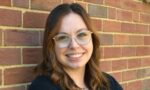
Today we’d like to introduce you to Sarah Stracke.
Hi Sarah, it’s an honor to have you on the platform. Thanks for taking the time to share your story with us – to start maybe you can share some of your backstories with our readers?
I am a studio florist and creative director, I own my own business based in Springfield, Missouri, with major touchpoints in St. Louis, Kansas City, and Bentonville, AR. I went to college for Art Education (BSED) and Studio Arts (BFA) at Missouri State University.
In college, my studio focus was photography, but I found Sculpture in my second to last semester and fell in love with the medium and concentrated on developing those skills my final year in college. With sculpture, It felt like I had finally found my artistic language.
Post undergraduate, I created a few sculptures that have made exhibitions in Springfield (Sculpture Walk of Springfield) and in Tucson, Arizona at the Sculpture Garden in the Side Yard at the Institute of Thoughts and Feelings. After graduating, in (2018), I quickly stumbled into an opportunity, assisting a local entrepreneur, Megan Morris (now, Stack) in starting up her new business The Ozark Mill & Finley Farms.
This opportunity sprang out of my desire to teach craft- arts (specifical woodworking) in a non-traditional educational environment, and from my lengthy resume in the the-coffee industry combined with the desire to teach, Megan saw that as a perfect combination of experiences to help her launch her first outlet for Finley Farms, The Workshop, a coffee shop and maker space in Ozark, MO.
So, I assisted Megan for about a year on anything she needed. I worked on brand integrity, brand development, design direction, retail curation and buying, menu creation, human resources/onboarding curriculum, teaching content and curriculum, guidelines for the workshops, photography, website content, and copy, etc. (Wearing any hat you can think of that a start-up business might need, I was running the social media accounts too when we first started!). I did that creative and project management work for about a year as we got the first business off the ground, “The Workshop” and then managed the restaurant for about a year and a half, before I felt the strong desire to get back to fully creative work (rather than management).
At that time, I knew it was the moment for me to step fully into floristry. A practice I learned in 2015 from an Ozark- Native, now NYC- inhabitor and dear friend, Alex Crowder. Alex taught me the basics of arranging over long-distance phone calls in 2015 in order to make and bring her mother a thoughtful birthday gift. Over text and call, Alex instructed me on foraging and sourcing blooms as a non-professional, without having the ability to go to a wholesaler and grab blooms (which has definitely informed the way in which I choose to do floristry today), in the Spring of 2015.
She had learned her craft from freelancing for several major florists in New York City (notable florists would be Saipua and Putnam and Putnam). It became a tradition, each year thereafter on Mother’s Day and her Momma’s birthday, that I would make her flowers in this way, like a surrogate daughter. Then in 2018, my best friend got engaged and asked me to do her wedding flowers. With the help of Alex placing orders, I asked for assistance from my friend Barrett in tackling this new feat. We arranged centerpieces upon centerpieces, bouquets, boutonnières, and bridesmaid’s bouquets.
We foraged from the venue site where she got married, cutting persimmons on branches and pulling mangled porcelain berry vine out of the trees to wrap around and drape from the light fixtures and to flood the mantle. It was magical (and so much work!), and I loved every second of it. After that, I had more friends asking me to do their wedding flowers, and two more couples approached me during that following year. Come 2020, I sprang into floristry fully after deciding my work at Finley Farms had been fulfilled.
In 2020, I launched Locust, my floral business. Which combines my love for art, nature, and floral design into one package as a service to couples and businesses. I use my passion for a sculpture by focusing on large-scale installations and my love for commissioned artwork, by working heavily from concepts with my clients. Using every aspect of what I learned in formal art school (all of the principles and elements of design, self-discipline, and studio practice), and the skills Alex taught me, plus years of self-teaching, studying, researching, and practice, and the entrepreneurial skills I developed while starting Finley Farms–to fuse the fulfilling compilation of my floristry business.
I chose to combine floristry with land -work and work part-time at Millsap Farms harvesting flowers after I left Finley Farms. Locust has close ties to the land, with a desire to mimic nature and to be careful and kind to the earth in how we choose to create in our space. So, I integrate practices that help me maintain that goal, like working at Millsap and exercising sustainable practices when possible. We source from local farmers first and as much as possible, then domestic, and lastly imported through wholesalers. We forage materials from lands we have access to. We compost at every event and in our studio.
In our design process, we meditate on what nature teaches us about how things grow and appear naturally in the world. 2020 and 2021, was busy, despite the pandemic, everyone wanted florals in their home for comfort while they were quarantined and weddings came back full-fledged in the summer of 2021.
How I define my services are as follows, “Locust places emphasis on sanctifying, heightening, and transforming space through floral design and specializes in concept-driven events, installations, and editorials. Locust caters to many floral design services from weddings, corporate clients, and dinners, to floral styling for brands, and arrangements for the home.”
As I describe my work, “Locust creates arrangements that feel like earth by unifying the natural world with careful design. Curating colors, flowers, and wild material to create shapes and gestures of outward growth, Locust’s designs transport onlookers to vast landscapes and lush gardens.”
I’m sure you wouldn’t say it’s been obstacle-free, but so far would you say the journey has been a fairly smooth road?
Covid was in full volume when I began my business, which offered some very unique challenges but also caused me to think in a way I may not have at first.
Springfield isn’t the most cutting edge location for an artistic-based floral design studio, which caused me to spread out into other major Midwestern cities, this has offered its challenges, but has molded my business into what it is today.
Being a one-man-band up until this point has been really hard, as a new small business it is hard to afford help, I ask help from many friends and family, and am now seeing enough growth to hire on assistance.
As you know, we’re big fans of you and your work. For our readers who might not be as familiar what can you tell them about what you do?
I focus on creating floristry work that is harmonious with nature. This often contrasts standard ideas of what floral design looks like –that means, fewer roses, more wildflowers, less tight bundles, more airy, wild spills. Less eucalyptus, more large branches, and moss. I love incorporating native and indigenous plant life, locust beans on branches, native bee balm, bittersweet vine, persimmons on branches, Queen Anne’s lace, and frost aster.
Finding and foraging these special ingredients takes a lot of time, education, and work. My practice is much more -outside- than most florists (which is an element of my work that I need, personally, but) finding these special ingredients that reflect our local bio-region pays off –you and I can notice/see the difference.
The challenge that comes with that? I often can’t find everything I need at a wholesaler, and that involves months of research, weeks of scouting, and education in how to harvest plants, what to take, AND when to leave them for other animals, insects, and plant life that may need it more than I do.
Along with this visual and design goal, we follow through with how that goal affects our relationship to the earth. We are learning and taking from it, so we want to be respectful in how we do that and how we give back to it. We compost every green scrap of matter from our studio work to events and we source locally as much as possible. (We love our farmers!!)
What was your favorite childhood memory?
My favorite childhood memories are camping with my family in the Ozark Mountains and along our little lakes and rivers in Missouri.
We had a hi-lo “pop-up” camper and my favorite memories are housed in that little cream rectangle. I still remember the hum of the air- conditioner window unit anchored to the top of the camper and can recall the texture of the upholstery on the pull-out bed that makeshifted as our dining bench.
My brother and I would ride endless loops around the campground’s circle drive and climb trees; we would often camp in a tent outside of the camper together just to see the stars through the netted ceiling of our fabric shelter.
Contact Info:
- Email: sarah@locustfloral.com
- Website: www.locustfloral.com
- Instagram: @locustfloral
- Facebook: locustfloral


 Image Credits
Abigail Derrick Photography, Courtney Lee Photography, Red Barn Studio for Onyx Coffee, and Alley Jeppsen Photography.