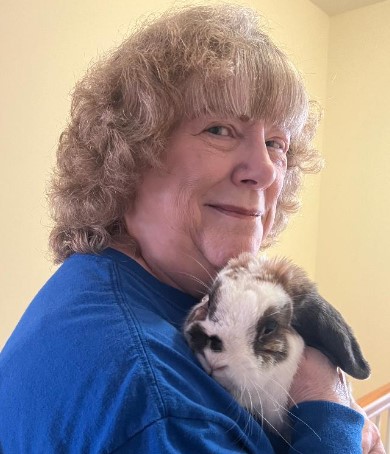
Today we’d like to introduce you to Joy Gioia.
Hi Joy, thanks for joining us today. We’d love for you to start by introducing yourself.
My first introduction to rabbits occurred when I was 10 yrs. old. My uncle brought me three baby cottontails from a nest he had run over in his yard. That was a long time ago. There were no formulas to be purchased and no supplies for orphaned animals. A call to our veterinarian provided a formula I could make at home and a baby bottle from one of my dolls proved workable. All three babies survived and I was able to do a successful release.
Quite a few years later, due to natural catastrophes from flooding in the area, I became involved in wildlife rehab, working with one local group and eventually helping to create an additional organization that is still active today. During that time, I was a shift supervisor, training instructor, and event fundraiser; I acted as an animal manager, provided triage and ICU care, and served on the board of directors. Although I worked with all of the animals and raptors, cottontails became my specialty.
Then one day, a park ranger brought in an injured rabbit found in a nearby park. It wasn’t a cottontail. It was my first introduction to the number of domestic rabbits abandoned when they are no longer wanted. I took her home and promptly found out how much I did not know about domestic rabbits. I had a lot to learn and that bunny helped in the learning. She was definitely not what I imagined a domestic pet rabbit was like. There are lots of tales I can tell about her.
Shortly thereafter, I had someone from animal control bring five domestic rabbits to me that had been caught after around 20 were turned loose on a city street by a breeder because the rabbits were no longer wanted. Those five were the only ones to survive. However, one was pregnant and delivered six babies the next day. Suddenly, I was overwhelmed, going from one to twelve rabbits.
A co-worker told me about a rabbit group that was being newly formed in the area. I got in touch, hoping to find a rescue that could take these bunnies. The group, however, was a handful of people getting together to share information and learn more about rabbits. It wasn’t a rescue. Knowledge was definitely beneficial, but it didn’t help find homes for all of the rabbits in my care. I became involved, ended up president of the organization, and started a rescue. We obtained our 501 (c) (3), and off we went.
Initially, there was one foster home, one part-time foster home, and all of the bunnies I had at my home. Then came the process of medical care, spays/neuters, supplies, housing, and more, plus developing an adoption protocol.
Soon, most of the fosters were in my basement. Slowly, some of our adopters became volunteers, enabling us to save more rabbits, which area shelters and animal controls were happy to have. The hard part initially was that we had no income, so every penny for rabbit daily care and medical care came out of my pocket. When our sons moved out on their own after college, my husband and I elected to sell our current home and build a smaller home, but one with a walk-out basement that could accommodate the bunnies. We had a small kitchen section and laundry spot, a tiny area for educating adopters, and ultimately, when expenses became too great to handle alone, a small store selling bunny supplies. This worked for 16 years, but we finally outgrew what we could handle in my basement.
It took two years of looking, but a 3 AM search while looking online once again, the perfect place popped up. This truly began an epic effort, but it happened, and in 2013, we were able to move into our own 5,000 sq. ft. shelter building. Over the last several years, we’ve added an additional 1,600 sq. ft., a small storage shed, then a 1,500 sq. ft. storage garage, and spruced up the 4-acre property.
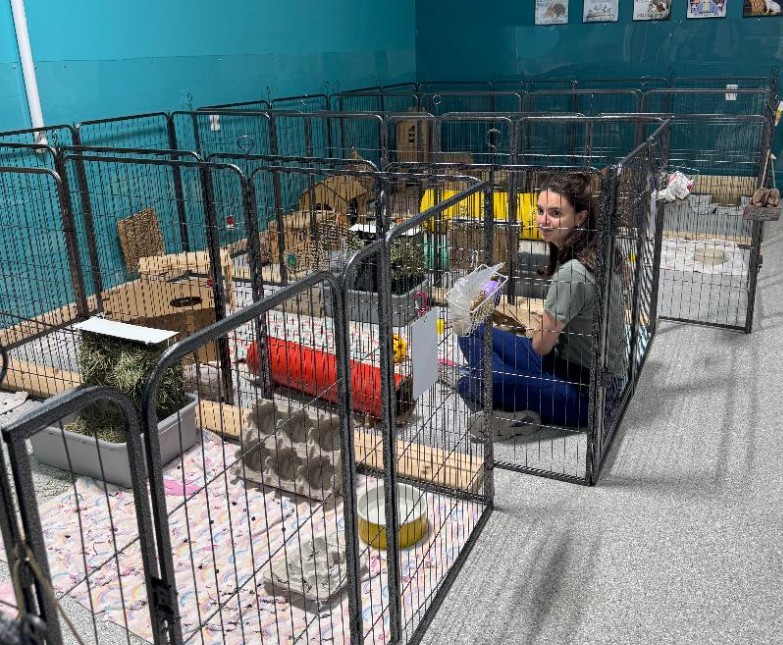
We now have a 1200 sq. ft. store, an 800 sq. ft education/activity room, an 800 sq. ft play area for the bunnies, three boarding rooms to help vacationers with bunnies, a volunteer kitchen, a Meet N Greet room for adopters to sit with potential bunnies, a medical room, and an isolation/Intake room, plus a large room for all of our adoptable bunnies. There are 150-160 foster bunnies with us at any given time. All of the bunnies have 48″ or 54″ double-door dog crates. We don’t use anything made for rabbits, as they are typically way too small or meant for the rabbits to live in their own filth with bedding. Spayed or neutered bunnies will use a litter box. All adopters attend a comprehensive class on rabbit care and behavior and must have appropriate housing and supplies before a bunny goes home. Rabbits that truly cannot be adopted go into our sanctuary program in homes where they are loved for the rest of their lives.
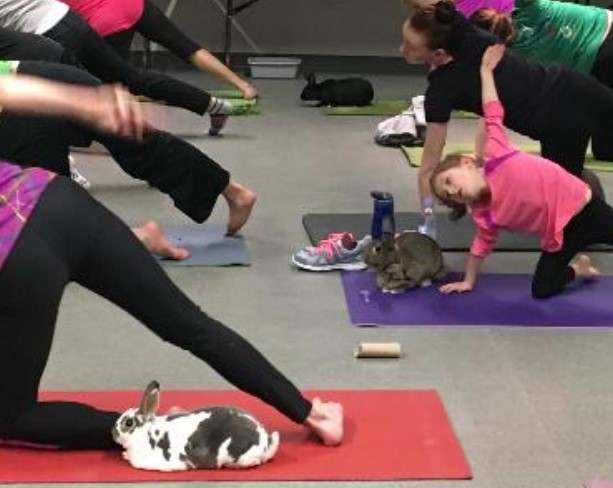
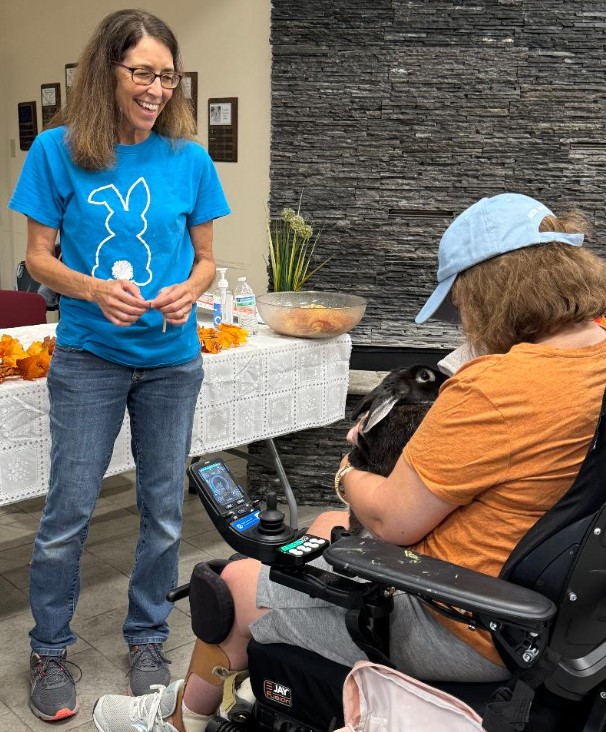
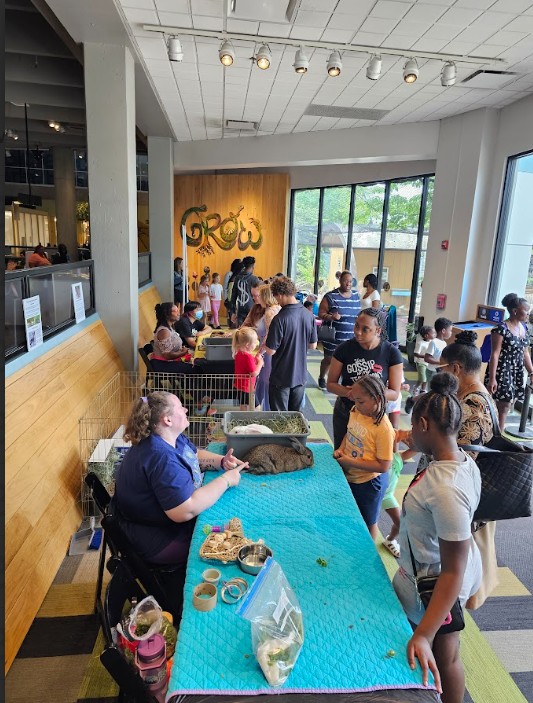
Education is a huge focus for us. We offer a variety of activities, lots of education for Girl Scouts, Boy Scouts, and other groups besides being involved with and invited to many community activities including an annual education event put on by the veterinary students at the University of Missouri, events at the St. Louis Science Center, inclusion in the Great Forest Park Hot Air Balloon Glow & Race, and a new program with the St. Louis Country Library system. We also help two wonderful organizations that work with special needs children and young adults. Although there’s a lot of work, we also have fun with many of our events.
We have offered two accredited Missouri conferences for veterinarians, plus hosted and helped plan a nationally accredited conference for rabbit educators and veterinarians. I have attended numerous veterinary conferences, learning more about rabbits, and spoken at national conferences.
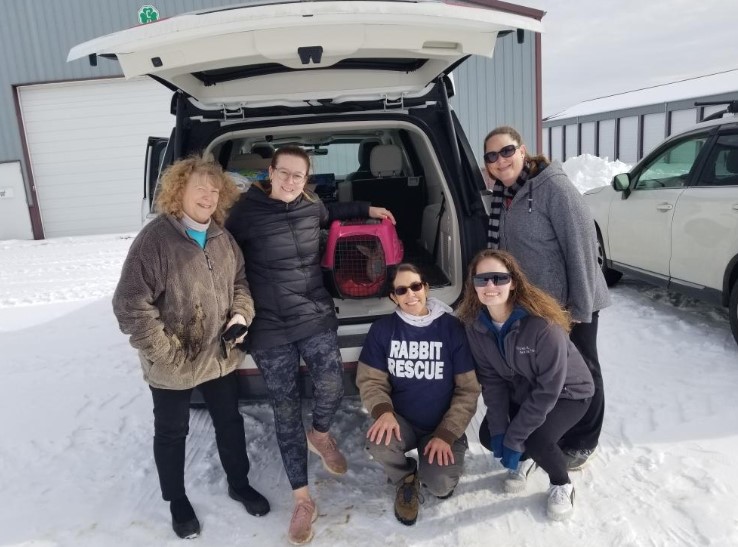
After 29 years, we are still a 100% volunteer organization, so every penny we make goes into providing for the rabbits in our care. That has helped us save thousands of rabbit lives. We have a volunteer rescue group that helps catch abandoned rabbits, and we’ve developed a specialized program working with traumatized rabbits to help them get adopted.
There is one thing I truly want to emphasize. One person cannot do all of this alone. The support of our tremendous volunteers is the true success story. The people who volunteer their time and talents, without pay, to help grow the organization, care for the animals, organize and volunteer at events, and crawl under bushes to catch loose bunnies are the true heroes. Without them, there would be no Missouri House Rabbit Rescue.
.
Can you talk to us a bit about the challenges and lessons you’ve learned along the way. Looking back would you say it’s been easy or smooth in retrospect?
Some of that is mentioned previously, but initially, having enough volunteers to help was a challenge. Raising funds to handle our ever-growing expenses was another. Then came the challenge of trying to get a major loan for our shelter building. First, we had to have 20% down because it was a commercial building. We did it. In fact, the video we put out to help raise funds is still on YouTube. https://www.youtube.com/watch?v=Y8_SBTIPH7M Simultaneously, we had to secure a loan. Try being an all-volunteer, bunny rescue asking for a huge loan. Fortunately, one bank took a look at our books, listened to our plans, and said, “Dang, we think you could actually pull this off.” For a commercial building, you can only obtain a 15 yr. loan, which means monthly payments are substantial. We never missed a payment.
Our supplies come in pallet loads. Shipping expenses are enormous. When shipping companies decided to start charging for requesting a delivery truck with a liftgate, things got tough. One company charged $100 every time the lift gate went up and down. We bought our own used forklift, and I learned how to use it.
Covid was the hardest challenge. We put a plan into place. The vast majority of our volunteers stayed with us. We maintained our distances, wore masks, and scrubbed with disinfectants. Not a day went by without the animals receiving full care. Our volunteers are the best.
As you know, we’re big fans of you and your work. For our readers who might not be as familiar what can you tell them about what you do?
Most of my professional experience has been in training. Helping others learn, both in a professional arena and in the rescue field of rabbits, just seemed to fit what I enjoyed doing.
We all have a different way of looking at and defining success. How do you define success?
Setting a goal and achieving it.
Contact Info:
- Website: https://morabbit.org
- Facebook: https://www.facebook.com/StLouisHouseRabbit